|
URI Community Greenspace Manual
COMMUNITY GREENSPACE
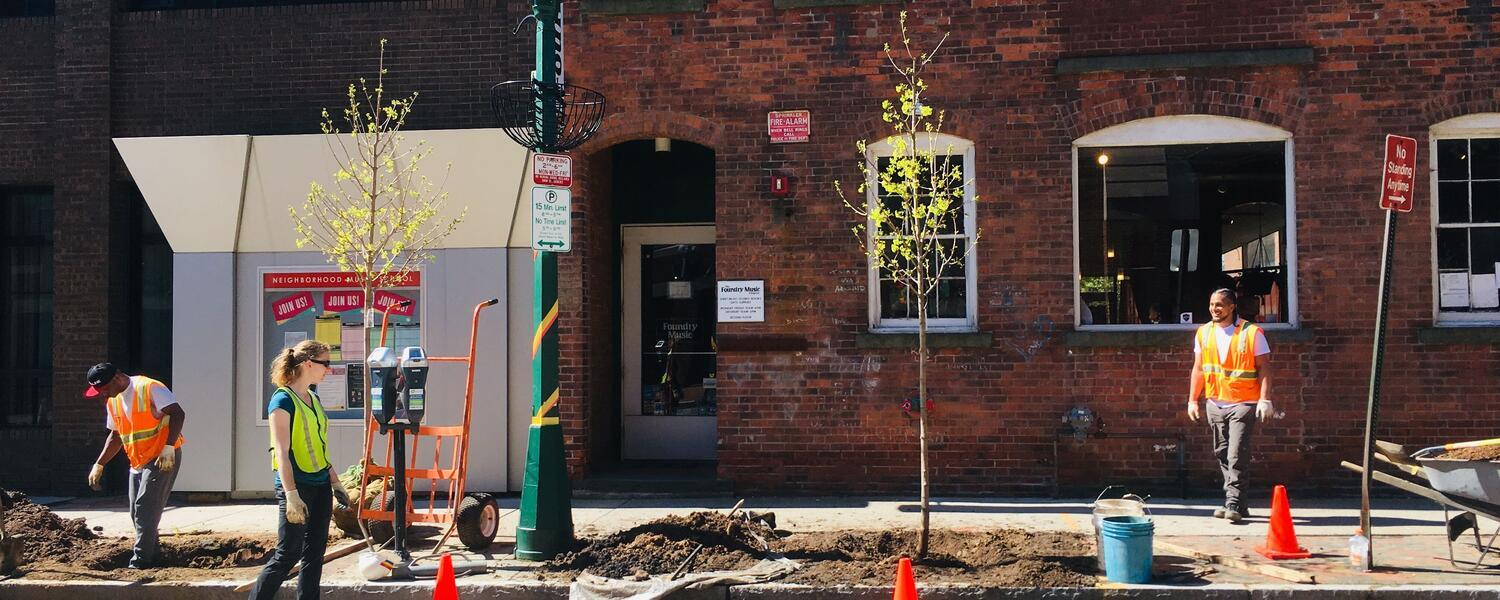
The Community Greenspace Program is a partnership between URI, the Community Foundation for Greater New Haven, and the City of New Haven. We also receive support from the Parks Department, the Department of Public Works, and United Illuminating. The most important partner, however, are the residents. You, and only you, will determine how much work you do and how successful it is.
This manual contains information that you will need for your project this summer and in the future. It includes lists of plants that we recommend for city planting, as well as information about composting, mulch, watering, and design. It also includes contact information about city departments that you may need in your greenspace work.
TREES
Why do we plant trees? Trees are an important asset to our city; they are part of the community’s infrastructure, just like streets, sewers, public buildings, and recreational facilities. The major difference is that trees are living organisms. They need care to survive, and the longer they live, the more benefits they provide. Trees also create opportunities for us to pull together as communities and to make our neighborhoods more desirable places to live in. Air Quality
Watershed
Habitat
Aesthetic Benefits
Economic Benefits
Social Benefits
Where do we plant trees? Trees can fill a variety of functions, depending on their placement and species. Trees in the curb strip:
Trees in a yard:
How do you choose your tree? Tree selection depends on the amount of sun that is available, the amount of space it has to grow, and the design of the space. Different trees also have different soil requirements, so it is a good idea to have your soil tested and to check the requirements of the tree you want to plant. Often residents on a street may want to plant similar trees along the street to create a pattern, but you should avoid planting all of the same species so that they do not spread disease so easily.
This manual includes a list of suggested trees for New Haven as well as lists of plants that do well in sun or shade. These lists will help you to choose a good tree.
SHRUBS
Why do we plant shrubs? Shrubs create an intermediate level between trees and perennials. They can create a base for your yard planting, backing up the flowers that you plant or hiding the foundation of your house. Because many of the shrubs that we recommend are evergreen, they cn anchor a planting and make it look nice year round.
Hedges also provide screening and privacy, and they can be used for traffic control. Specimen plantings are special shrubs, with interesting flowers, leaves, or branches, that you plant to attract attention.
Also consider the wildlife you may attract with your plantings. Shrubs provide screening for animals and birds, and their berries will attract both native birds and migratory birds that are passing through.
Where do we plant shrubs? Plant shrubs against the foundation of your house to draw the eye up from the lawn or garden to the building. Plant them at corners to soften the edges of a building. In a yard, try to layer your planting with three levels of height: tall, medium, and short. Shrubs can provide the tall or medium level.
Plant shrubs along a path or walkway to prevent pedestrians from walking across a lawn or lot. Plant them at the back of a lot to discourage people from wandering too far in.
Remember that shrubs can also hide intruders, so be aware of the screening that you create. Make sure that hedges meant for privacy do not create an obvious hiding place. Shrubs can also collect garbage in highly trafficked or windy areas.
How do we choose? Look at the list in this manual of recommended shrubs, and consider whether you want evergreen or deciduous shrubs, what their sun requirements are, how quickly they grow (and to what size), and how they will look with your other plantings. Also consider the size of the shrubs as compared with the scale of nearby buildings.
PERENNIALS
Why do we plant perennials? Perennials are plants that grow and flower every year (URI does not offer any annuals, which are plants that only last for one year). Many of them die back to the ground in the winter and grow again in the spring. Perennials create interesting textures, colors, and patterns in a garden. They include flowers of all kinds as well as many grasses and groundcovers, so they can be used in all kinds of plantings designs.
Where do we plant perennials? Perennials can fill up a garden plot in front of your house or in the curb strip. They can be planted along fences or used to border walkways. Masses of perennials can fill up a space in an abandoned lot, either as a low maintenance, wildflower garden, or a more formal bed. Remember to consider the size of the full grown plant when you make your planting design. Plant the tallest perennials behind the lower ones. Also think about when they will bloom, and combine plants so that there is always something interesting in your garden.
How do we choose perennials? Make sure that you know how much sun your plot receives. Many perennials require full sun, so if you have a shady garden you should make sure that you choose shade loving plants. Also consider how much water the plants need.
As with any planting, look at the scale of your space. Small plants work best for a small space or as the first layer of planting in a large space. It’s also usually best to plant at least a few of each species: most perennials look best as a small group (although very large plants or plants with a very special bloom, leaf, or shape might be used as a specimen).
Don’t forget to consider all 4 seasons when you plant! Combine plants for year-round interest!
GROUNDCOVERS AND VINES
Why do we plant groundcover? Groundcover holds the soil together, provides an attractive open space, and covers areas that other plants won’t grow on. Groundcover can be the most low maintenance part of a planting if you choose it well.
Traditional groundcover such as ivy, pachysandra, or vinca will cover areas where grass won’t grow. Lawns, which require more maintenance, can provide a useable part of a yard space for play or picnicking, or just for appearance. Like other groundcover, grass holds the soil, and it is very durable. Some low perennials, like lamium or wild geranium, can also be used for groundcover, and these plants, though generally not as durable as grass, will provide seasonal interest in an open space.
Where do we plant groundcover? Plant groundcover everywhere! It’s good for the earth; it holds the soil together and helps to capture moisture. You can spread groundcover in an open space or use it around the edges of a planting bed to fill in between perennials and shrubs. Vines will climb walls, fences, and porches, bringing green even to the vertical spaces around your home or yard.
How do we choose? As with other plantings, consider how much sunlight and water a space will receive. Consider maintenance; if you are planting grass, are you sure that someone will be able to water and mow it? How much traffic does the space get? If the plants are likely to be trampled, make sure to plant something durable.
TREES
Amelanchier x grandiflora Serviceberry ("Cumulus") Serviceberry bears white flowers in the spring and has good fall color (orange, red, yellow), with edible fruit that is attractive to birds. Be sure to use single tree form trunks, branched at 6 feet, if you are planting along the street. Serviceberry also grows in a clump form that can be planted in yards or lots. Height: 15-25 ft., Spread: 15-25 ft. Slow growth rate. Partial shade to full sun.
Acer saccharum Sugar Maple ("Green Mountain") The sugar maple is a fast growing, upright tree, with dark green leaves and beautiful fall colors. It is somewhat sensitive to poor soils and drought and needs a large, unpolluted space to grow in. NOTE: Maple trees are susceptible to "Verticillium Wilt," a plant disease that causes leaves to wilt and die. This has been a problem in New Haven in recent years. They are also sensitive to salt, which can be a problem in the winter, when the roads are salted. Height: 50-75 ft., Spread: 40-60 ft. Fast growing. Partial shade to full sun.
Carpinus betulus European Hornbeam The european hornbeam is a sturdy tree with an attractive trunk (light in color, with a notched texture). Its fall leaf is yellow, and it bears inconspicuous, white blossoms. Although this tree can grow to 50 feet, it is slow growing and can be used under high wires. Height: 25-50 ft., Spread: 25-35 ft. Slow growing. Full shade to full sun.
Cercis canadensis Redbud ("Forest Pansy") This small tree has deep rose / purple flowers with heart-shaped leaves that are reddish at first, becoming dark green and then yellow in the fall. The redbud may have multiple trunks but can be pruned to a single trunk for use as a street tree. It is a lovely tree but is somewhat delicate; it requires moist soil and should not be planted in hot, dry sites. Height: 25-30 ft., Spread: 25-30 ft. Partial shade to full sun.
Cornus kousa Dogwood ("Kousa," "Chinese," "Japanese" Dogwood) The kousa dogwood, a small, full tree, is typically low branched but can be pruned to grow in a tree form suitable to street planting. Its creamy white flowers last several weeks in the early summer, and its red berries are attractive to birds. Leaves are dark green, turning reddish purple in the fall.
Fraxinus pennsylvanica Green Ash The green ash is a full-crowned, conical tree that is tolerant of poor soils. Its foliage, which is dark green, turns yellow to bronze-red in fall. NOTE: Although in general the green ash is tolerant of stressful city conditions, it has in recent years been subject to decline in New Haven, so any plantings should be carefully considered. The variety "Marshall’s Seedless" is recommended for street plantings because seed pods from female trees can be messy on sidewalks. Height: 50-60 ft., Spread: 35-45 ft. Fast growing.
Gingko biloba Gingko The gingko is an exotic, very durable tree that tolerates most soils, drought, pollution, compacted soils, and a confined root zone. Its shape is quite unusual, with an irregular branching pattern off of a single trunk. Leaves are fan-shaped and turn bright yellow in fall. NOTE: The female gingko bears a smelly fruit; plant only male trees. (Watch out for the "Stinko of the Gingko!") Height: 50-70 feet, Spread: 35-50 ft. Moderate growth rate.
Gleditsia triacanthus inermi Honeylocust (Thornless varieties) The thornless honeylocust provides light, filtered shade, as it bears branches with very small leaves. It is late to leaf in the spring and is one of the first trees to lose its leaves in the fall, after they turn yellow and copper. Because the leaves are small, they require minimal raking in the fall. The honeylocust is fairly hardy. NOTE: Select only thornless and seedless varieties! Height: 50-75 ft., Spread: 35-50 ft. Fast growing. Partial shade to full sun.
Koelreuteria paniculata Golden Raintree This medium sized tree is graceful in form, with a broad, round crown. It bears bright yellow, lacy flowers (about 1 foot long) in mid-summer, which give way to brown, papery seed capsule. Leaves are bluish green, turning yellow in the fall. This tree is tolerant of urban conditions and is useful either as a street tree or as a lawn specimen. Height: 25-40 ft., Spread: 25-40 ft. Slow growth rate.
Liquidambar styraciflua Sweet Gum The sweet gum requires moist soil. Its shape is pyramidal, rounding out as it matures. It has star-shaped, glossy leaves that turn bright orange to crimson and bronze in the fall, and it bears a woody, spherical seed capsule that can be a nuisance. Height: 50-70 ft., Spread: 30-50 ft. Slow to moderate growth rate.
Malus x Crabapple ("Snowdrift" and other varieties) The crabapple bears a white blossom in spring and bears persistent fruit: small orange and red apples. It tends to grow in clump form but can also be trained to a single trunk. Height: 15-25 ft., Spread: 20-30 ft. Moderate growth rate. Full sun.
Platanus acerifolia London Plane The london plane tree has a strong, straight trunk with mottled, grey and brown bark that flakes off in late summer and fall. It is a durable tree with a broad crown that creates good shade; fall coloring is a dull yellowish brown. NOTE: The london plane tree is susceptible to a fungal disease called anthracnose. Use the resistant cultivar, "Bloodgood."
Prunus x cistena Purpleleaf Plum This small, ornamental tree bears copper red leaves that deepen to dark purple and then turn greenish bronze in late summer. It bears showy white flowers in the spring, with a crop of small red plums later. Height: 25-30 ft., Spread: 15-20 ft. Fast growing. Full sun.
Prunus subhirta ‘Pendula’ Weeping Japanese Cherry A small ornamental tree with weeping branch habit, bearing pink flowers in early spring. Not for use as a street tree (hanging branches obstruct visibility from the street): generally used as a specimen planting.
Prunus subhirella ‘Autumnais’ Autumn Flowering Cherry This cherry bears semi-double pink flowers in early spring and then again in October. Height: 25-35 ft., Spread: 25-35 ft.
Quercus rubra Red Oak The red oak is a common sight in New Haven. It is a large tree and will spread out to 50 feet and beyond, with a single trunk and very full branching patterns. The red oak is tolerant of poor soil, including drought and salt. It does not bear obvious blossoms, but it does have beautiful red and brown coloring in the fall. Height: 50-75 ft., Spread: 50-70 ft. Fast growing.
Stewartia pseudo-camellia Japanese Stewartia This tree flowers in early June, it has exotic, flaking bark, and is insect and disease free. It also has excellent fall color. Japanese Stewartia should be planted in moist, well-drained soil. It is a small tree, good for yards.
Styphnolobium japonicum Japanese Scholar Tree / Pagoda Tree The Scholar Tree flowers in late summer, bearing creamy white clusters of bloom although flowering generally does not begin until after age 10. Foliage is bright green, turning yellowish-green in the fall. This tree is tolerant of urban stresses and is useful as a street tree, providing light shade. However, seed pods and blossoms may create a mess on the sidewalk. Height: 40-60 ft., Spread: 30-60 ft. Fast growing. Full sun.
Syringa reticulata Tree Lilac The tree lilac is a small tree that can be planted under low wires. Its most distiguishing characteristic is its flower, a large white blossom that blooms in early spring and is sweet smelling. The foliage of the tree lilac (alo called the Japanese tree lilac) does not change color in the fall. NOTE: Be sure to use only tree form varieties as street trees. Height: 15-25 ft., Spread: 10-15 ft. Moderate growth rate. Full sun.
Tilia cordata Linden ("Greenspire" or "Littleleaf") The linden is a fairly large tree, and like the oak it is tolerant of both wet and droughty conditions, although it does not do well in salty soil. It has fragrant, yellowish-white blossoms throughout sumer that attract bees and birds, and it turns yellow in the fall. Height: 50-75 ft., Spread: 35-50 ft. Moderate growth rate.
Prunus sargenti, Prunus subhirtella Sargent Cherry, Higan Cherry These are both good street trees that can be used under utility wires. Both bear pink blossoms and have attractive fall colors: the Sargent cherry turns copper, orange, red, and yellow, and the Higan cherry turns mostly yellow. NOTE: The columnar version of the Sargent cherry (Prunus sargenti columnaris) is a narrow, upright tree that can be used in constricted spaces. Height: 25-50 ft., Spread: 15-35 feet (Sargent cherry tends to be somewhat shorter and broader than the Higan cherry). Fast growing.
Pyrus calleryana Aristocrat Pear (also use Bradford and Red Spire Pear) These trees are useful under wires. They bear white blossoms in the spring and red foliage in the fall. The difference between the 3 varieties is in the shape of the crown. Aristocrat pears tend to branch outward, Bradford pears tend to be rounded, and Red Spires tend to a vase-like shape. These trees are tolerant of poor soil and stressful city conditions. Height: 25-50 ft., Spread: 25-35 ft. Fast growing.
Zelcova serrata Zelcova ("Green Vase") The zelkova is a large, full tree with a lovely vase-like shape. It foliage is quite dense, with fall colors of copper, red, orange, and yellow. Height: 75-80 ft., Spread: 50-60 ft. Moderate growth rate.
SHRUBS
Buddleia davidii Butterfly Bush ("White Harlequin" and other species) This is a shrub with long, woody stems, like forsythia; it can be treated as a perennial in planting designs. In the spring and summer it bears beautiful clusters of small flowers ranging from white to lavender and deep purple. Its foliage is silvery green. This plant really doe attract butterflies! Height: 6-10 ft., Width: 6-10 ft. Full sun.
Euonymus fortunei Spreading Euonymous Different varieties of euonymous are very useful for borders and yard plantings. Euonymous may range in size from 1 foot high to 12 feet, and growth habits may include a leggy habit or a very contained, rounded shape. Many varieties are evergreen; they bear a larger leaf than most hollies, and a number of these are variegated in color (green and white or yellow and white), so they provide a nice contrast to the textures of other evergreens. The deciduous variety, "Burning Bush," turns a deep crimson in the fall, but it can be invasive by seed. Spreading euonymous has a green leaf and a green and white bloom. Other varieties include Emerald Gaiety (variegated white and green leaf) and Manhattan (evergreen). Height: 6-10 ft., Spread: 6-10 ft. Partial shade to full sun.
Chaenomeles speciosa Flowering Quince This hardy, deciduous shrub is among the first to bloom each year, with flowers that may be pink, red, or white. It is a woody plant, like witchhazel and butterfly bush, and it bears dark green leaves that do not change color in the fall. Height: 6-10 ft., Spread: 6-10 ft. Partial shade to full sun.
Cotinus coggygria Smoke Tree ("Royal Purple") The smoke tree or smoke bush is an exotic looking tree with dark green or purple foliage that turns scarlet to orange in the fall. It bears large, fringe or hair-like flowers in mid-summer, giving it a cloudy effect. Height: 10-15 ft., Spread: 15-25 ft. Full sun.
Hamamelis virginiana Witchhazel Witchhazel is essentially a small tree. It bears bright yellow, ribbon-like flowers in fall and winter, and fall foliage is also yellow. Height: 15-25 ft., Spread: 15-25 ft. Full shade to full sun.
Hydrangea macrophylla Hydrangea Hydrangea is a wonderful specimen plant that bears large clusters of white, pink, red, or blue flowers in the spring and summer. Many gardeners will tell you to plant pennies with hydrangea; the copper from the coins will turn the flowers blue. It has large, toothed leaves and grows in a symmetrical, rounded shape. It prefers fairly rich soil and should be well watered. Height: 4-6 ft., Spread: 6-8 ft. Partial sun to shade.
Ilex crenata Japanese / Box Leaved Holly This holly is an attractive evergreen with dense, erect branches and dark green, oval leaves. It is extremely hardy and grows naturally in an attractive, rounded form—useful for foundation planting. Height: 6-10 ft., Spread: 6-10 feet. Full sun to full shade.
Ilex glabra Inkberry Holly This is a broadleaved evergreen, bearing inconspicuous white blossoms and black berries that are attractive to birds. Height: 6-10 ft., Spread: 6-10 ft. Partial shade to full sun.
Juniperus chinensis Chinese Juniper Dwarf varieties of juniper are very useful in planting beds and as a groundcover. Juniper is extremely hardy and has many different, appealing growth habits, from spreading mats, to round shrubs, to conical tree forms. Chinese juniper grows either in upright form or as a spreading bush. Its leaf may be green, gold, yellow, or variegated. Height: 24-36 inches, Spread: 8-15 ft. Partial shade to full sun.
Juniperus virginiana Juniper / Redcedar This evergreen shrub is native to North America seashore regions, so it is tolerant of salt and poor soils. Its green and yellow blooms are inconspicuous, and it bears purplish-blue berries. Height: 25-50 ft., Spread: 15-25 ft. Fast growing. Partial shade to full sun.
Leucothoe fontanesiana Fetterbush / Leucothoe Leucothoe bears pink and white flowers in the spring and foliage that turns an attractive purple in the fall. It is a hardy shrub, good for urban conditions, and includes some evergreen varieties. Leucothoe is also good for shady locations. Height: 4-6 ft., Spread: 24"-6 ft.
Ligustrum vulgare Privet Privet is frequently used throughout the city to create hedges, although residents should be aware that it loses its leaves in the winter. It bears white flowers in the spring and summer, and its fruit is a black or purplish-blue berry. It will grow in dry soil and is fairly easy to transplant. Height: 10-15 ft., Spread: 10-15 ft. Moderate growth rate.
Lonicera tatarica Honeysuckle Honeysuckle is a fast-growing, deciduous shrub that bears white, yellow, or reddish-pink flowers. It is a wetlands plant but will also tolerate dry soil. Its leaves are bluish-green and do not change color in the fall. Height: 10-12 ft., Spread: 10-12 ft. Fast growing. Partial shade to full sun.
Microbiota descutensis Russian Cypress A low growing evergreen with soft foliage that turns purple in the winter. Russian cypress can spread to 10 feet and will grow in partial shade.
Myrica pensylvanica Bayberry Bayberry is a wonderful, spreading shrub that bears dark green, glossy leaves with a sweet fragrance similar to that of bay leaves. Its flowers are inconspicuous, its fruit is attractive to birds, and it is semi-evergreen. Bayberry is also native to Connecticut. It works well in combination with inkberry holly.
Pinus mugo var. mugo Mugo Pine This slow growing, evergreen shrub can grow to a range of sizes and can also be trained to a single trunk. Dwarf varieties grow in a round, symmetrical shape. Mugo pine bears an inconspicuous yellow bloom and will tolerate dry soil and moderate drought. Height: 36"-12 ft., Spread: 6-12 ft. Slow growing, Partial shade to full sun.
Pinus thunbergii Japanese Black Pine This large pine is very fast growing and will tolerate poor soil, making it a good choice for city planting. Its dense branches spread, hanging low at the base and creating a broad pyramid at top. Height: 15-25 ft., Spread: 15-25 ft. Full sun.
Potentilla fruticosa Cinquefoil / Potentilla This is a slow growing, deciduous shrub which bears yellow flowers and foliage that turns slightly copper before it falls. It is tolerant of dry soils and is useful in planting schemes because it blooms in late summer to fall. It can be used as a border or groundcover and is especially effective when planted in masses. Height: 11"-4 ft., Spread: 2 ft.-4 ft. Partial shade to full sun.
Rosa rugosa Rugrose / Saltspray Rose This hardy bush rose bears small, fragrant flowers that may be white, pink, purple, or red. Its rounded green leaves turn yellow in the fall. Height: 4-6 ft., Spread: -6 ft. Full sun.
Syringa x (‘florea’ and other species) Lilac Lilac bushes bear large, fragrant clusters of small blossoms that range in color from white to pink and purple. Lilac flowers in the spring and its foliage, though deciduous, does not change color in the fall.
Viburnum plicatum tomentosum ‘Mariesii’ Doublefile Viburnum Viburnum is a wonderful plant, native to Connecticut, with interest in all seasons. It is a large shrub with white flowers that bloom in May and dark red berries that birds love. It has a horizontal branching habit—excellent for seasonal screening—and is insect and disease free. Some varieties are deciduous; others are evergreen. Height: 10-15 ft., Spread: 15-25 ft. Partial sun to shade.
PERENNIALS
Achillea millefolium Yarrow Yarrow has a tall stem with flat, round clumps of tiny flowers. It bears pink, purple, lavendar, white, or yellow bloom which attracts butterflies. Yarrow is tolerant of dry conditions and is good for erosion control, massing, and as a groundcover. Height: 2-3 ft. Prefers full sun.
Alchemilla Lady’s Mantle Lady's Mantle is a low-mounding or carpeting herb with rounded leaves that grow in a star-like pattern. Yellow-green, feathery flowers grow on stems about 1 foot high. Height: 1 ft. Sun to partial shade.
Aruncus Goat's Beard Goat's Beard is a tall plant with long, leafed stems and tall, feathery spikes of tiny, creamy-white flowers that bloom in early to mid-summer. It works well as a border or accent in a large garden. Height: 5-6 ft. Partial sun to partial shade.
Aster novae-angliae New England Aster This aster bears orange, pink, purple, red, or white flowers and has a jagged green leaf. It blooms in late summer to mid fall and tolerates dry soil Height: 3-6 ft.
Bergena Saxifage / Megasea Saxifage has low clumps of attractive, evergreen foliage that is bright green to purple. Flowers bloom in early to mid-spring; they are purplish-red, pink, or white, and stand a foot above the leaves. Height: 1-1 1/2 ft. Partial sun to partial shade (more sun in cool climates).
Cimicifuga Bugbane This tall perennial grows best in shaded, woodland areas. It bears pointed leaves, divided into 3 parts, and tall white flowers on stems up to 2 ft. long. Height: 3-8 ft. Partial to full shade.
Coreopsis verticillata Coreopsis ("Moonbeam") This is a fairly hardy flower, tolerant of drought, with yellow bloom and fast growth. It has a wildflower look and looks nice as a border or in masses. It blooms in mid to late summer and attracts birds and butterflies. Height: 18-24" Partial sun to shde.
Dianthus Dianthus A low flower in a variety of colors, with hardy, grass-like leaves. Dianthus is evergreen. Height: low Full sun.
Eupatorium pupureum Joe Pye Weed This tall plant bears pink, purple, and white bloom in mid summer to early fall. Its purple foliage creates a nice contrast in gardens. Joe Pye Weed works well in woodland gardens or for a naturalizing effect, and it attracts butterflies. Height: 7-10 ft. Partial sun to shade.
Euphorbia polychroma Spurge Spurge bears a yellow bloom from late spring to early summer and nice foliage; it is a good border or groundcover. Height: 12-18" Full sun.
Festuca ovina glauca Blue Fescue Fescue is a low, grassy plant with blue bloom and a silvery leaf. It blooms from mid to late spring. Height: 6-12" Full sun.
Geranium Cranesbill Geranium is a bushy plant that can be upright to trailing / sprawling. It bears many-lobed, toothed leaves and saucer-shaped flowers that bloom throughout the spring, summer, and fall (often with two blooms). Flowers are white, pink, purple, or blue, often with veins in contrasting colors. Height: 4-24" Sun to shade (the hotter the climate, the more shade it needs).
Helianthemum nummularium Rock Rose The rock rose bears an orange, pink, red, white, or yellow bloom from late spring through mid summer. It is a low plant with a compact, rounded shape. Height: 8-14" Full sun.
Helianthus maximilliani Maximillian Daisy This tall daisy bears a yellow bloom in late summer through mid fall. It is drought tolerant. Height: 6-8 ft.
Helleborus Lenten Rose This small plant grows in compact mounds. It has palm-shaped leaves up to 2 ft. across, lasting through the winter until new leaves emerge in the spring. Flowers are small bells, white, pink, rose, purple, or green, and bloom in the spring. Height: 1- 1 1/2 ft. Partial sun to shade (prefers more shade in hotter climates).
Hemerocallis x. Daylily Daylilies bear an array of bloom: orange, pink, purple, yellow, red, and variegated. It does well as a groundcover, under bushes, or along a path, though the stalk looks somewhat stringy when it is finished blooming. It blooms in late spring, through the summer, and in early fall. Height: 3-4 ft. Partial sun to full shade.
Heuchera micrantha Alumroot / Coral Bells Alumroot has a white, pink, or red bloom in late spring and early summer, and its leaf is purple and green. Height: 8-12" Full sun to full shade (prefers some shade).
Hosta x. Hosta / Plantain Lily Hosta has a long, wide leaf that may be green, silvery, yellow, or variegated. It is a hardy plant, useful as a groundcover, and bears purple and white flowers at the end of long stalks in late summer and early fall. Height: 18-20" Partial to full shade.
Liatris spicata Blazing Star Aster This plant bears a purple and white bloom in late summer and early fall. It has an attractive green foliage and is good for foundation planting and massing as well as for cut or dried flowers. Height: 18-36" Full sun.
Lobelia Cardinal Flower Tidy basal leaves rise into tall, flowering columns. Leaves are green to reddish-purple, growing to about 6 inches. Flowers bloom in mid- to late summer; they are spiky and are red or blue. Height: 4-5 ft. Partial sun to shade
Miscanthus sinensis Maidenhair Grass This tall, ornamental grass bears a pink bloom in late summer and fall. It grows quickly and attracts birds: good as a groundcover or foundation. Height: 6-8 ft. Partial sun to full shade.
Monarda didyma Bee Balm Bee balm is a large plant with beautiful pink, red, and white flowers, and fragrant foliage. It blooms all summer and attracts butterflies. Bee balm is a spreader and can be invasive. Height: 30"-4 ft. Partial sun / partial shade.
Nepeta x. faassenii Catmint Catmint has a purple bloom all summer and silvery, fragrant foliage. It is a nice border and attracts butterflies. Height: 1-2 ft.
Oenothera speciosa White Evening Primrose The primrose has large, fragrant, pink and yellow blooms in mid to late summer. It is fast growing and can spread aggressively, so it should be planted in a confined space. Height: 1-2 ft. Full sun.
Papaver orientale Oriental Poppy This flower has orange, pink, purple, red, or white flowers which bloom in mid to late spring. It has a jagged green leaf. Height: 2-3 ft. Full sun.
Phalaris arundinacea Ribbon Grass Ribbon grass has a variegated leaf and a white flower which blooms in early summer. Ribbon grass is a spreader and can be invasive, so it should be planted with care. Height: 18-36" Full sun to partial shade.
Rudbeckia fulgida Coneflower / Black-Eyed Susan This is a yellow flower with a black center (there is also a purple variety); bloom is in late summer to early fall. Height: 1-2 ft. Full sun.
Santolina chamaecyparissus Lavender Cotton An attractive plant with silvery, fragrant, evergreen foliage. Good for borders, foundations, and massing. Lavender bears a yellow bloom in late summer to early fall and will tolerate dry to moist soil. Height: 12-18" Full sun.
Sedum spurium Stonecrop / Sedum Red and white bloom in mid to late summer; a drought tolerant plant, with hardy leaves that make it look like a desert plant. Height: 4-8"
Solidago x. Goldenrod Goldenrod has a yellow flower and is drought tolerant. It flowers in late summer and early fall, and the "Golden Fleece" variety provides a late, long-lasting bloom. Height: 1-2 ft.
Stachys byzantina Lamb’s Ears This is a fast growing, hardy plant with a pink and purple bloom and soft, silvery leaves. It blooms from late spring through mid summer. Height: 6-8" Full sun.
Viola Violet Violets are low, spreading plants with heart- or ivy-shaped leaves and white, violet, red, or yellow flowers that bloom in the spring. Violets work well as a border or groundcover. Height: 4-12" Sun to partial shade.
Yucca filamentosa Adam’s Needle / Yucca Yucca has good leaf structure and looks like a cactus. It bears a tall, white flower on a long stem. Height: 2-3 ft.
GROUNDCOVER / VINES
Aegopodium podagraria Bishop’s Weed / Goutweed This is a hardy, deciduous perennial with blue-green leaves, edged in white, and white flowers that bloom in the late spring to early summer. It forms a dense mat with stems around 6 inches tall and flower stalks from 12-18 inches tall. Goutweed grows quickly, especially in full sun; it can be very invasive and should be planted with care. It tolerates poor soil and dry conditions. Height: 6-15" Sun to shade.
Ajuga reptans Bugleweed / Ajuga Ajuga is a very hardy, evergreen groundcover that is useful for curbstrips because it can withstand some abuse. It grows best in partial sun to light shade but will withstand a variety of sun and moisture conditions. It bears a small blue or pink flower in the spring. Height: up to 6" Sun to partial shade.
Euonymus fortunei Wintercreeper Euonymous A fast growing, hardy, evergreen groundcover. This euonymous spreads to 4 feet and will climb walls and trellises. It has inconspicuous white flowers with summer bloom and pointed, leathery, dark green leaves. The foliage of the "Coloratus" variety (purpleleaf wintercreeper) turns arious hues of purple in the fall and winter.
Galium odoratum Sweet Woodruff Sweet woodruff is a low-lying, spreading perennial with swirls of 2-4 inch leaves on square stems and clusters of small white flowers that bloom in the spring to mid-summer. It has the sweet aroma of fresh hay. Sweet woodruff dies back in the fall but renews itself easily in the spring. It is a very useful groundcover, growing easily in the shade. Height: 6-8" Partial to full shade.
Hedera helix English Ivy A fast growing, evergreen groundcover with dark green leaves and a viney stem. It bears tiny white flowers in the fall. Ivy is quite hardy and is tolerant of drought. Height: 6-12" Sun to shade.
Lamium galeobdolon Dead Nettle / Yellow Archangel Dead nettle bears green leaves with silvery splotches; its leaves turn pink to purple in the summer. Laium keeps its leaves except in the coldest climates, and it bears yellow flower spikes in late spring and early summer. Height: 1-2 ft. Shade.
Liriope spicata Creeping Lilyturf Liriope is a grass-like, evergreen groundcover characterized by clumps of coarse, dark green or variegated, blade-like leaves. It has pale lavender, spike-like flowers which bloom throughout the summer. Lilyturf forms a dense cover spreading by underground stems. Height: 6-12"
Pachysandra terminalis Pachysandra Pachsandra is an evergreen vine / groundcover with veined, dark green leaves that grow in clusters. It spreads rapidly, using underground runners to create a dense, level cover. Pachysandra bears small white blossoms in the spring. Height: 6-10 inches. Shade.
Phlox subulata Phlox Phlox is a mat-forming perennial that produces a 6 inch carpet of brilliant color that lasts for about a month in late spring. The flowers range from white to sades of pink and red. A very popular plant for front yards and perennial beds, phlox is hardy and grows in most soils with good drainage. Height: 6-12" Full sun.
Vinca minor Creeping Myrtle / Periwinkle Vinca is a lovely evergreen groundcover with glossy, dark green leaves and white or purple spring bloom. It grows quickly but can be hard to establish and is not as hardy as ivy or ajuga— it should not be planted in an area which gets a lot of traffic. Height: 6-12" Partial to full shade.
CLIMBING VINES
Clematis x. Clematis Clematis works well on arbors and walls, especially in combination with roses. Clematis bears blossoms in a variety of colors including lavender, red, blue, and white. It prefers moist soil and requires at least partial shade. Height: 8-10 ft.
Lonicera semppervirens Trumpet / Coral Honeysuckle A fast growing, deciduous vine with brilliant, orange-red flowers that bloom in the spring and summer. This vine requires at least partial sun. Height: 3-20 ft.
Wisteria floribunda Japanese Wisteria Wisteria is a large, climbing vine with multiple woody trunks. It bears large clusters of fragrant flower in the spring that may be blue, lavender, purple or white. Wisteria is deciduous, and its foliage turns yellow in the fall. It is fast growing and requires at lest partial sun. Height: 15-30 ft., Spread: 40-50 ft.
PLANTS FOR SUNNY SPOTS
Trees All trees that are listed may be planted in sunny spots.
Shrubs Buddleia davidii, Butterfly Bush Chaenomeles speciosa, Flowering Quince Cotinus coggyria, Smoke Bush Euonymus, Euonymous (many varieties) Hamamelis virginiana, Witchhazel Ilex crenata, Japanese / Box Leaved Holly Ilex glabra, Inkberry Ilex verticillata, Winterberry Juniperus chinensis, Chinese Juniper Juniperus virginiana, Juniper / Redcedar Ligustrum vulgare, Privet Lonicera tatarica, Honeysuckle Myricus pensylvania, Bayberry Pinus mugo, Mugo Pine Pinus thunbergii, Japanese Black Pine Potentilla fruticosa, Cinquefoil / Potentilla Rosa rugosa, Rugrose Syringa x., Lilac
Perennials Achillea millefolium, Yarrow Aster nove-angliae, New England Aster Clematis x., Clematis Coreopsis verticillata, Coreopsis Euphorbia polychroma, Spurge Festuca ovina glauca, Blue Fescue Helianthemum nummularium, Rock Rose Helianthus maximilliani, Maximillian Daisy Liatris spicata, Blazing Star Aster Nepeta x. faassenii, Catmint Oenothera speciosa, White Evening Primrose Papaver orientale, Oriental Poppy Rudbeckia fulgida, Coneflower Sedum spurium, Stonecrop / Sedum Solidago x., Goldenrod Stachys byzantina, Lamb’s Ears
Groundcover Aegopodium podagraria, Bishop’s Weed / Goutweed Ajuga reptans, Ajuga / Bugleweed Euonymus fortuneii, Wintercreeper Euonymus Hedera helix, English Ivy Liriope spicata, Creeping lilyturf Phlox subulata, Phlox
PLANTS FOR SHADY SPOTS
Trees Acer saccharum, Sugar Maple Amelanchier x. grandiflora, Serviceberry Carpinus betulus, European Hornbeam Cornus kousa, Kousa Dogwood Fraxinus pennsylvanica, Green Ash Gingko biloba, Gingko Gleditsia triacanthus inermi, Honeylocust Koelreuteria paniculata, Golden Raintree Liquidambar styraciflua, Sweet Gum Monarda didyma, Bee Balm Platanus acerifolia, London Plane Tilia cordata, Linden Zelcova serrata, Green Vase Zelcova
Shrubs Hydrangea macrophylla, Hydrangea Ilex x., Varieties of Holly Leucothoe fontanesianai, Fetterbush / Leucothoe Viburnum plicatum tomentosum ‘Mariesii’, Doublefile Viburnum
Perennials Alchemilla, Lady's Mantle Eupatorium purpureum, Joe Pye Weed Geranium, Cranesbill Helleborus, Lenten Rose Hemerocallis x., Daylily Heuchera micrantha, Alumroot Hosta x., Hosta Miscanthus sinensis, Maidenhair Grass Phalaris arundinacea, Ribbon Grass Viola, Violet Yucca filamentosa, Yucca
Groundcover / Vines Ajuga reptans, Ajuga / Bugleweed Euonymus fortunei, Wintercreeper Euonymous Galium odoratum, Sweet Woodruff Hedera helix, English Ivy Lamium galeobdolon, Dead Nettle Liriope spicata, Creeping Lilyturf Pachysandra terminalis, Pachysandra Vinca minor, Creeping Myrtle / Periwinkle
PLANTS FOR WINTER INTEREST
As you choose plants to fill your design, remember to account for each season. Make sure that your plant selections will provide interest all year round, especially in the winter. You may also consider using structures, like benches, paths, or a trellis, to create interest and structure when most plants are not in flower or leaf.
Trees Cornus sericea, Red and Yellow Twig Dogwood: colored bark Cornus kousa, Kousa Dogwood: bark Magnolia stellata, Star Magnolia: bark, buds
Shrubs Aronia: red berries in winter Euonymus x, Euonymous (various species): some species of euonymous are evergreen Ilex crenata, Boxwood / Japanese Holly: evergreen Ilex glabra: black berries in winter, evergreen Ilex meseveae, Blue Holly: red berries in winter, evergreen Ilex verticilata, Winterberry Holly: red berries in winter (foliage is deciduous) Itea: red fall foliage, semi-evergreen Juniperus chinensis, Chinese Juniper: evergreen Juniperus virginiana, Juniper / Redcedar: evergreen Kerria: green stems Leucothoe, Fetterbush / Leucothoe: winter foliage Microbiota Descutensis, Russian Cypress: evergreen, purplish foliage Myrica pensylvanica, Bayberry: semi-evergreen, blue winter berries Pieris: evergreen, red stem, flower buds Pinus mugo: Mugo Pine: evergreen Pinus thunbergii, Japanese Black Pine: evergreen Rosa rugosa, Rugrose: red rose hips in winter Taxus, Yew: evergreen Viburnum opulus, Viburnum: winter berries Viburnum rhytidophylum, Allegheny Viburnum, Leatherleaf Viburnum: evergreen
Groundcover Ajuga reptans, Bugleweed / Ajuga: evergreen Euonymous fortunei, Wintercreeper Euonymous: evergreen Hedera helix, English Ivy: evergreen Liriope sppicata, Lilyturf: evergreen Pachysandra terminalis, Pachysandra: evergreen Vinca minor, Myrtle / Periwinkle: evergreen
PLANTS FOR HABITAT
Trees, shrubs, and flowers can provide homes and food for wildlife. The types of plants that you use will determine which species are attracted to your backyard. Consider native species first, and try to plant a variety of species that flower and bear fruit at different times of the year.
Plants for Birds Trees: American Beech, American Holly, Apple, Balsam Fir, Black Cherry, Black Gum, Cottonwood, Crabapple, Flowering dogwood, Hawthorns, Hickories, Oaks, Mulberry Shrubs: Common juniper, Highbush blueberry, Hollies, Pyracantha, Red-osier dogwood, Serviceberry, Spicebush, Sumacs, Viburnum Vines: American Bittersweet, Native Honeysuckle, Strawberry, Trumpet Creeper, Virginia Creeper, Wild Grape Flowers (especially for hummingbirds): Aster, Bee Balm, Columbine, Coneflower, Coreopsis, Delphinium, Fuschia, Honeysuckle, Jewel Weed, Lobelia, Penstemon, Phox, Salvia, Sunflower, Trumpet Creeper
Plants for Butterflies Aster, Butterfly Bush, Butterfly Weed, Coneflower, Lantana, Lupine, Milkweed, Phlox, Zinnia
Plants for Bees Honey bees will help to pollinate and spread your flowers—remember that they do not sting! Bees are attracted to most flowering plants, and are especially fond of blue and yellow flowers. Try planting your garden so you have different species blooming in the spring, summer, and fall. Plants for bees include: Bee Balm, Black-Eyed Susan, Cardinal Flower, Clover and other legume, Cosmos, Crape Myrtle, Goldenrod, Lupine, Mallows, Milkweed, Mints, Sunflower
Plants to attract Scavengers Festering Roadkill, Poison Milkweed, Mandrake Root, Garbage Scraps
Water for Wildlife Clean, fresh water is as important to birds, bats, and other wildlife as it is for people. Water in a saucer, bird bath, or backyard pond gives wildlife the water they need. Remember to change the water every few days to keep it fresh. In hot weather, it may be necessary to refill the container every day.
DESIGN
As you begin a Community Greenspace project, make sure that you devote plenty of time to planning. Look at your site: what are its characteristics—both good and bad? How do you hope to change it? How do you hope to shape it to a particular use? Become familiar with the shape of the land, pre-existing plants, the nearby structures and architecture. Then spend some time mapping out a plan and choosing your plants. Start with examining the space's function—then consider its design, and only then begin to select your plants.
The following section includes some basic guidelines to help you plan your space and choose your plants:
Scale: Elements in your project should be in scale with the size of your space, its surroundings, and with each other.
Human Scale: What elements exist that passers-by can relate to? How can you make the space more (or less) inviting? Next to a walkway, use flowers or shrubs with a delicate texture or leaves that can be appreciated up close. If plants will be viewed from more of a distance, then overall shape, form, and color are more important than these details.
Use: "Form follows function!"
Repetition: Repeat elements in your planting such as color, texture, and shape. You might want to alternate species in a regular pattern, or choose a theme (such as a particular color) to tie together your plantings. Variety creates interest, but plants should share something in common in order to create unity in a planting design.
Variety: Variety adds liveliness to a design. Change elements to create diversity, opposition, and contrast.
Balance: Balance refers to a general equilibrium of the parts of a design, so that the whole has a sense of stability. One kind of balance is to look at your design as though it were divided along a vertical axis; try to create the same amount of mass on either side, or repeat patterns of planting. Another type of landscape balance is perspective balance between the foreground, the middle ground, and the background of a design. In other words, be aware of which elements attract the most attention (like a bed of extremely colorful flowers), and try not to let this overpower the rest of your scheme.
Emphasis: Emphasis is the process of differentiating the more important from the less important. You can emphasize a particular plant by setting it apart spacially, by using intense colors or striking shapes, or creating an unexpected contrast. For instance, a flowering shrub in the midst of a row of evergreens will draw attention, as will a free standing specimen tree against a background border of low-lying perennials.
Sequence: Sequence is a uniform change, movement, or transition of the design qualities, leading in a particular direction. Patterns of change will draw a viewer's eye from one element to another, thus connecting the parts of a design. A sequence should lead the eye to a particular goal, like a special planting bed or a building / structure. Be aware of how the size and shape of plants lead the eye; a useful pattern is a three tiered sequence. You might plant a low row of perennials against a group of medium sized shrubs, which is in turn backed by a larger tree or shrub.
Defining a space Make sure to define the edges of a planting bed, the borders of a lot, or the corners of a yard. Clear boundaries give your planting focus and structure, and they encourage people to use particular paths of travel rather than cutting across your greenspace. For instance, pedestrians or bikers are less likely to cut the corners of a yard if it is lined with a hedge, a groundcover, or even a row of small stones.
PLANNING YOUR DESIGN
Process: Follow these steps to make sure your plan is well thought out..
Your analysis should include consideration of the other residents near your space. Make sure that you talk with everyone who will be affected by the planting so that you can agree on how you want to change the space or how you want to see it used.
PLANT SELECTION A plant that has foliage (leaves or needles) year-round is an evergreen. Evergreens may have a broad leaf, like a holly, or a needle, like a pine. A plant that drops its leaf in the fall and re-leafs in the spring is deciduous. This will be important as you consider the effect of your planting in the winter. Plant forms can be horizontal or upright, weeping or trailing—these natural forms can be used to your advantage as you create a design that is shapely but low maintenance. You can also create harmony with plant color—not only from flowers, but also from foliage, bark, and berries. This manual includes seasonal information about plants recommended for New Haven.
While perennials add color and detail to your greenspace, its structure is defined primarily by trees and shrubs. A single tree can set the scale of a landscaped space, and you may decide to set a special tree or shrub apart as a "specimen plant," a kind of centerpiece. A row of trees will enclose a space, provide a screen for privacy, act as a windbreak on northern exposures, provide a physical and visual barrier to adjoining spaces, and, during summer months, provide shade.
Shrubs also provide screening and create enclosures. In season, they can create a colored border filled with texture and fragrance. The light reflected off of broad leafed shrubs provides a lovely glow during winter months. Always remember to select shrubs and trees for their size at eventual maturity.
Keep it simple! Don't use too many different types of plants, sizes, shapes, forms, and colors. Use fewer plants and mass them together in groups for stronger effect and easier maintenance. Different plants will work together well if they are similar in size, shape or form—then they will read together as a whole.
Spacing Always keep in mind the height and spread of plants. Place taller plants in the background, medium sized plants in the middle, and low groundcover in front. Don't place plants too close to a building—remember that they will grow! Plan for the mature size of the plant.
Seasonal Interest Consider all seasons in your design. Use plants that have 4 season appeal: spring flower, summer greenery, fall leaf color or berries, winter branch habit. Flower gardens may be strong in spring and summer but completely bare in the fall and winter: use evergreen plants so that you will have color in the winter as well.
Maintenance Be reasonable about how much time you have for maintenance. Again, keep it simple! Complicated designs with many different types of plants will be very time consuming to maintain.
See the lists of suggested plants and combinations to choose species…
COMPOST
What is composting? Composting is the process of decay; organic material (like leaves or food scraps) decomposes and becomes rich soil…natural fertilizer!
How to use compost Mix compost with your garden soil to improve it and to provide more nutrients for your plants. Try to use about 1 part compost per 2 parts soil. If you only use compost in your planting, plants can become root-bound: their roots will wrap around in the area with compost, and they won’t extend further into the soil. Try to mix the compost and the soil well.
What’s the difference between compost and mulch? Compost is a ready-to-use soil enricher that looks and feels like dark, crumbly soil. Mulch is any material used to cover soil in order to hold in moisture and to repress weeds.
How to Compost
Best recipe:
This pile should produce finished compost in about 30 - 60 days.
Urban garden recipe:
You can keep adding material, but it will take longer to be ready.
When is it finished? Compost is ready when it is dark brown or black, crumbly, and smells like soil. You shouldn’t be able to see any food scraps in it.
MULCH
Why mulch? Mulching is one of the simplest and most beneficial practices you can use in the garden. Mulch is simply a protective layer of a material that is spread to top of the soil. Mulches can either be organic—such as grass clippings, straw, bark chips, and similar materials—or inorganic—such as stones or brick chips.
Mulch Materials Bark Mulch: Small chips are easiest to spread, especially around small plants. Excellent for use around trees, shrubs, and perennial gardens. When spreading mulch around trees, keep the mulch an inch or two away from the trunk. Apply to a depth of 2 inches. Wood Chips: Similar to bark mulch. Apply to a depth of 2 inches. Leaves: It is best to chop and compost leaves before spreading them. Apply to a depth of 3-4 inches. Grass Clippings: You can use grass clippings as a mulch, but do not apply them too deeply, as they will compact and rot. Do not use clippings from lawns treated with chemicals. Apply to a depth of 2-3 inches. Newspaper: You can apply sheets of newspaper and cover them lightly with grass clippings or other mulch material.
When to apply mulch Mulch regulates the soil temperature; in the summer, it keeps the soil cool, and in the winter it keeps it warm. Make sure to apply mulch before the ground freezes in the winter, and after it thaws in the spring. You can continue using mulch as needed throughout the summer.
PLANTING
Many trees are killed right at the start. Nationwide, about 20% of all new street trees die soon after being planted. Some die quickly, usually because the roots were allowed to dry out in the sun or wind before planting. Others don't show the effects of poor planting until years later, when they blow over because of poor root development, or they are girdled by wires that were not removed. Experts estimate that if a tree is planted correctly it will grow twice as fast and live twice as long as one that is incorrectly planted.
PRUNING
Why Prune?
When to Prune
Points to Remember
Trees are pruned principally to preserve their health and appearance and to prevent damage to human life and property. In pruning, your aim is to control and direct growth, not to drastically alter the natural growth habit or structure.
How you prune will affect the tree permanently. Young trees are usually pruned to direct their growth; older trees are pruned as a response to physical damage or disease.
There are many factors to consider before you decide to prune, but one simple rule to follow is evaluate first, prune second.
Prune for Health Damaged, dead, and diseased branches are pruned to prevent disease organisms from penetrating into the tree's healthy parts and to reduce the spread of diseases to other trees. This type of pruning can be performed anytime it is necessary.
Thinning is a common practice that reduces the tree's height and spread while retaining its natural shape. Proper thinning increases air circulation and allows more sunlight to penetrate the innermost leaves. Start while the tree is young. When forced to choose between two crossing branches, prune the weaker of the pair. Prune entire branch to its point of origin. Remove branches that point inward or rub against other branches. Be careful not to overprune, however: too much thinning can reduce the tree's food production and weaken it.
Winter is a good time to check the tree. Careful observation is the best way to locate problems. Key symptoms to look for: blackened branches, shriveled bark, swollen or misshapen branches, or fungus growing on a branch. Remove any diseased limbs immediately and thoroughly clean pruning tools afterwards.
Prune for Appearance Pruning can maintain or restore the characteristic form of a tree, using a combination of aesthetic and practical considerations. Removing an elongated limb may bring the overall shape of the tree back into balance, creating a pleasing, less lopsided form.
Thin stems ("basal suckers") often grow up from the base of the tree. Besides being unsightly, they suck energy from the tree and ultimately can weaken it. Prune them away as soon as they first appear. Keep in mind that the suckers may reappear in the future and more pruning may be needed.
"Water sprouts" resemble basal suckers, but they grow from the branches. They can result from improper pruning of the tree. Like suckers, they deplete a tree's energy and mar its shape. Remove water sprouts immediately.
Prune for Safety Broken, split and dead branches are a hazard along city streets. Low-hanging branches must be removed so that sidewalks and streets are clear to a height of six feet. Branches that obscure clear vision of traffic signs must be removed.
WATER, WATER, WATER
Water is crucial for tree survival. Watering is especially important immediately after planting, to settle the soil, to bring it into contact with the roots, and during the first year of growth while the tree replaces roots lost during its move. Watering should continue for at least 3 to 4 years after planting and can even benefit mature trees during hot. Dry summers.
Water your tree immediately after planting and once a week during dry weather in the spring and summer. Reduce watering during the fall to allow the tree to harden off for the winter. Young trees should be watered slowly and deeply to encourage deep rooting: if you water only lightly, roots will move to the surface where they will dry out quickly.
Use about 10 gallons of water a week: this means turning a hose on low power for one hour, or five buckets of water. Spraying the leaves of newly planted trees with a mist of water during hot weather helps them stay healthy. Mature trees generally store enough water, but you may water them during long, dry spells with a lawn sprinkler; about two inches is sufficient (you can check this by placing a tin can in the watering area).
Don't apply more water than the soil can absorb: too much water can actually drown a tree!
Watering Your Garden Once the weather gets warm, people start calling in to report serious problems with their plants. Careful questioning reveals that over 75% of these problems are the result of improper watering techniques. Whether you plant annuals, perennials, herbs, or nursery stock, you MUST be sure to pay attention to proper watering techniques during the first year of their life in your garden or the plants will fail to thrive and possibly even perish! Watering plants sounds simple enough, but it can be one of the trickiest and most deceptive activities that you can do in your garden! You must water DEEPLY twice a week for the first three weeks and at least once a week thereafter for the first growing season to ensure success with your new plants. We often have extended periods of severe drought in Connecticut, in spring or fall as well as summer. Be sure to monitor this and be aware of just how much rain has fallen in your yard each week. The best time to water is in the morning. Plants will use the water that you give them all day; at night the plants are inactive, and their roots can rot if you water extensively at the end of the day. The best tool a gardener can have is a rain gauge. Although countless fancy models are sold in every gardening catalog, the basic premise is to put out a container to catch rain and measure the number of inches received. Most perennial gardens thrive on an inch of rainfall per week. Since that only happens in a perfect world, we as gardeners have to take up the slack. The first step is to honestly assess how much rain has fallen. Even if we have three cloudy, cool, drizzly and uncomfortable days in a row, we may actually only receive less than 1/8 inch of rain during that period. Never assume that a day of showers has soaked in enough to water your garden. The worst thing that you can do is to lightly "sprinkle" the plants and the surface of the soil each day when you get home from work. Although this may feel good psychologically, it isn't doing the plants any favors! Light watering causes all roots to grow up to the surface. Once there, they are apt to dry out much more often as the heat of the sun will simply dessicate them each day… and you are caught in a vicious cycle of constant watering and wilting! Instead, water deeply so that the water penetrates down into the root zone, at least 6" or more. For shrubs or large perennials, the ideal way to do this is to put the hose at the base of the plant and turn it on to a low trickle. WALK AWAY from the plant and leave the water on for at least one half hour. Be sure a well of soil has been created around each shrub so that the water isn't all running away from the plant and truly does soak down into the ground. When you are done, if you aren't sure how deeply the water has gone, take a trowel and dig down. It should penetrate 6" or more down to the root zone. Overhead sprinklers often look and feel like they are watering the garden, but you would be surprised how long you have to leave them on in order to really saturate the toot systems. Put out a cup and catch the water from an overhead sprinkler. How many hours does it take to accumulate one inch in that cup? They are very wasteful of water as well, as they often reach outside of the garden to the driveway or sidewalk. Watering from above poses other problems, too. If you put sprinklers on your garden at night, you dramatically increase the opportunities for fungus on your plants, especially roses and phlox. Always water in the morning. Finally, sprinklers miss plants. In our shade garden, the water hits the leaves of the giant 'Big Mama' hosta and rolls away. Big Mama doesn't get a drop. It also hits the two tree trunks, and all of the plants behind the trunks are missed as well. Lawn irrigation systems cannot be expected to water a perennial garden. They are on a different time schedule- they usually come on every night for 15 minutes or a half hour, which isn't nearly enough for the deep watering needed. Overhead pop up sprinklers also beat the plants in the gardens, and night watering increases the incidence of plant disease. I can always tell by the look of a garden if the customer is using a lawn irrigation system. The plants show it. A better system is to use soaker hoses. These are laid on the soil surface and covered with mulch. Some people even bury them beneath the soil, especially on steep hillsides. Water oozes out of the pores in the hose very slowly, deeply soakin ghte soil. You leave these hoses on for many hours, but they actually conserve water because so little water comes out at a time. Because the water doesn't migrate very far from the hoses, the secret to installing them is to weave them very tightly among the crowns of the perennials or shrubs. We pin them down with landscape fabric staples to keep them in place. After installing them, run the water for a few hours, then dig around to see how deeply and how far the water has penetrated. You may need to add more hoses or run the system longer. Once you have figured it out, THEN bury the hoses. Leave them in place all year round. If you accidentally break them or dig into them while gardening, simply use a hose repair coupling to fix them. You don't even have to bring them in for the winter! Most systems only have enough water pressure for 100 - 150' of soaker hose. Large gardens may need more than one "run" of hoses, irrigating a section at a time. Soaker hose systems can be put on a timer, making them virtually worry-free. If you are on a well and can't run a hose for more than 15 - 20 minutes, let the well recover and then turn it back on the same garden or individual plant again. Do this until that one garden is deeply watered. The next day, water a different garden. Your best friend in a drought is healthy soil, highly enriched with compost and thickly mulched with an organic material such as shredded bark. This holds in moisture, and you will have to water less frequently. If you think about how plants work, these watering techniques will make sense. If you implement, them, your gardens will be much healthier.
Water Quality What's the Big Deal? Water. Who even thinks about it? Every day it comes out of the tap, then goes down the drain and that's the end of it. O.K., sometimes it tastes a little funny but that's no big deal. If you want to go fishing or swimming, head to the local stream or swimming hole or maybe even take a trip down to Long Island Sound. Nothing to worry about—Connecticut's got clean water to spare, right?
There are plenty of reasons to worry about water. Just ask someone with a contaminated well, or a clamor in a town where the water has been closed to shellfishing due to pollution—they'll tell you that water, both in terms of quantity and quality, is not to be taken for granted. We expect to have crystal-clear, pure water for drinking, food production, and recreation AT THE SAME TIME our waters are used for waste disposal. The phrase, "the solution to pollution is dilution" typifies the old feeling that anything dumped down a drain, into a river or even into the ocean is going to disappear without a trace. We now know that NO aquatic system, even an ocean, can absorb unlimited human pollution without overwhelming the natural system.
So why doesn't someone stop water pollution? The need to prevent water pollution has been recognized for years. The federal and state Clean Water Acts were passed in the early 1970s specifically to prevent industry and sewage treatment plants from discharging excess pollutants into water. While these sources have not been eliminated, they are smaller than they were thirty years ago. We now know the problem is much more complicated than simply ordering a plant to stop discharging pollutants. For one thing, with plants eliminating many toxic pollutants, it has become clear that previously unsuspected materials also cause environmental problems. For example, sewage treatment plants treat their discharges to remove pathogens, ammonia, and BOD, or the organic material that would remove oxygen from the water as it decomposes. Now that treatment plants meet these standards, it's been found that nutrients, previously considered a harmless part of the effluent, are pollutants.
Factories and sewage treatment plants are only two sources of water pollution. Pollutants fall from the sky, wash from the land during rain storms, travel across the state in streams and rivers, and even get dumped into storm drains or the water by wildlife or thousands of individuals who don't realize that what they are doing may cause water pollution. All of these different sources of pollution get lumped together under the term "nonpoint source pollution."
Through our every day activities, we all cause water pollution without realizing it. The exhaust and oil from driving cars, materials washed down drains or flushed down the toilet, pet wastes, fertilizers and pesticides used in yards, all contribute to water pollution. Some pollution can be prevented by making simple changes in our daily practices. For example, conserving water saves money and helps septic systems or the local sewage treatment plant function properly. Choosing non-toxic alternatives for household cleaning products reduces water pollution, cleaning bills, and our exposure to hazardous materials. Maintaining the yard with Sound Gardening practices reduces the need for pesticides, fertilizer, and water, thus reducing the potential for contaminating local waters.
These are just a few examples of personal efforts that protect water quality. There are many materials available with information on different ways to help prevent water pollution. Please take some time and find out how you can help protect our most important natural resource—clean water.
SOILS
The following explanation is from a fact sheet published by the Connecticut Agriculture Experiment Station, located at 123 Huntington St. in New Haven. The "Ag Station" offers free services to New Haven residents, including free soil tests and pest identification. To have your soil tested, take a bag of soil mixed from different layers of your garden soil (to about a foot in depth) to the testing department. They will send you the results, along with recommendations for amending your soil.
To contact the Soils Department, call 974-8607. The main number is 974-8500.
Soil Testing Soil tests, when supported by information on cropping history and past soil treatment, serve as a guide to intelligent use of fertilizers, lime, and other soil amendments. Information from soil tests cannot correct plant problems caused by insects or disease or site limitations such as not enough sunlight.
SOIL TEXTURE: Texture influences the amount of water and nutrients a soil can hold. Sands, loamy sands and sandy require more frequent watering and lose nutrients more readily by leaching than do fine sandy loams and loams. Silt loams, silty clay loams and clay loams may retain excessive moisture and reduce aeration of plant roots.
ORGANIC MATTER: Organic matter also influences the amount of water and nutrients held by the soil. High organic soils have better structure and retain nutrients and water better than Medium organic soils. Low organic soils may be improved by the addition of organic materials such as compost.
PH: Soil pH affects the availability of nutrients and, when interpreted with texture and organic matter, indicates the limestone needs of the soil. The results are expressed in pH units, with pH 7.0 being neutral. Connecticut soils are generally somewhat acidic in the pH range of 4.5 to 6.5. Most plants except for rhododendrons, azaleas, mountain laurel and blueberries grow best at a soil pH between 6.0and 7.0.
LEAD in the Garden
High lead levels are a fact of urban life. Lead is present in the urban environment in many forms. Much of the lead is in the soil, and accumulates around lead-painted buildings that have weathered, or have been scraped, sanded or sandblasted. Sites once used for factories or dumping can also have lead present in the soil. Airborne particles from industrial emissions and auto exhaust also add to lead contamination in backyards, on streets, in playgrounds, parks, or gardens.
Lead can be a hazard to humans, particularly young children under six years. The major concern is with direct contact with lead dust in soil or on paved surfaces. Gardeners and children who play on soil with a high lead content may breathe in or swallow contaminated soil or dust. Leaded dust can collect on greens and other vegetables and will add to a person's daily lead intake. Daily exposure to lead from soil, dust, air, food and other sources can cause chronic low level lead poisoning in adults as well as young children, sometimes without obvious symptoms.
Precautions… There are precautions you can take to make sure you and your children can garden and play safely. Here are some we recommend:
Precautions for Children
Precautions for Gardeners
Avoid bringing lead dust into the house:
NEW HAVEN RESOURCES
Urban Resources Initiative
Colleen Murphy-Dunning, Director: 432-6570 Intern Phone Number at URI: 432-6189
City Agencies and Organizations
Abandoned Autos and Illegal Dumping: 946-6316 Call Before You Dig: 1-800-922-4455 City Plan Department: 946-6378 Community Foundation for Greater New Haven: 777-2386 Ana Arroyo, Greenspace Program Director Connecticut Agriculture Experiment Station: Information: 974-5500 Soil Testing: 974-8521 Insect Inquiries: 974-8600 Entomology: 974-8604 Plant Inquiries: 974-8601 Plant Pathology: 974-8606 Department of Public Works: 946-7700 Emergency Number, Bulk Trash, Debris in Street, Household Hazardous Waste, Leaf Pick-Up, Pothole Hotline, Recycling, Yard Waste Collection, Snow Removal, Street Sweeping Landfill / Transfer Station 946-8109 Department of Parks, Trees, & Recreation: 946-7700 Public Information: 946-8021 Park Security: 946-7268 Recreation Information Line: 946-8030 USDA Natural Resource Conservation Service: 787-0390 Carol Donzella, Project Coordinator
Livable City Initiative
Neighborhood Specialists Beaver Hills: Elaine Braffman 946-7835 Dixwell: Linda Davis 946-7888 Downtown: Frank D'Amore 946-7884 Dwight: Jose Romero 946-7730 East Shore: Jackie Ortiz 946-8266 Fair Haven: Nkechi Obiha 946-7732 Hill: Velma George 946-7731 Newhallville: Thelma Ragsdale 946-7733 Westville: Mark Nichols 946-8562 At Large: Paul Wessel 946-7090
Senior Neighborhood Specialist: Frank D'Amore 946-7884 Deputy Director, Neighborhood Services: Gary Hogan 946-8248 Project Manager, Greenspace / Community Gardens: Doreen Larson-Oboyski, 946-8381
Community Policing: Substations
Beaver Hills: 386 Whalley Ave, Sgt. Whitney Epps 946-7065 Dixwell: 26 Charles St, Sgt. Herman Badger 946-7566 Downtown: Sgt. Michael Pachesa 946-7827 Fair Haven: 255 Blatchley Ave, Sgt. Everett Nichols 946-7377 Hill North: 88-90 Hallock St, Sgt. Ariel Melendez 946-7273 Hill South: 410 Howard Ave, Sgt. Leo Bombalicki 946-7504 Newhallville/East Rock: 596 Winchester Ave, Sgt. Richard Rohloff 946-7572 Westville/West Hills: 333 Valley St, Sgt. Thaddeus Reddish 946-7560 81 Brookside Ave 946-2979
Management Team Meetings
Main Committee 2nd Wednesday of the month, 6 pm Citywide Council: YFC, 560 Ella Grasso Blvd Sub-Committee Executive Committee: 1st Monday of the month, 5:30 pm 200 Orange St., Rm. G2 Economic Dev. & Jobs: Last Monday of the month, 6 pm 200 Orange St., Rm G2 Strengthening Neighborhoods: 1st Wednesday of the month, 5:30 pm CFGNH, 70 Audubon St. Empowering Ind. & Families: 3rd Tuesday of the month, 6 pm YFC, 560 Ella Grasso Blvd Education: 2nd Tuesday of the month, 5:30 pm 165 Church St., Meeting Room 3
Management Teams
Dixwell: 3rd Thursday of the month, 7 pm GNH Bus./Prof. Association, 192 Dixwell Ave. Dwight: 1st Tuesday of the month, 6:30 pm Dwight School, 130 Edgewood Ave. Fair Haven: 1st Thursday of the month, 6 pm Fair Haven Police Substation, 255 Blatchley Ave. Hill North: 2nd Tuesday of the month, 6 pm Hill North Police Substation, 88-90 Hallock St. Hill South: 3rd Wednesday of the month, 6 pm Hill South Police Substation, 410 Howard Ave. Hill EC: Last Wednesday of the month, 6 pm YFC, 560 Ella Grasso Blvd Newhallville: 4th Tuesday of the month, 6 pm Newhallville Police Substation, 596 Winchester Ave. West Rock: Last Wednesday of the month, 5 pm West Rock Development Corp., 295 Wilmot Rd. |