

Points of Departure


Treasure Underground

If time travel existed, Jesse Thompson and Tony Cwikla would have racked up millions of frequent flier years. They’re history buffs—guys who’d prefer to throw back ale with Benjamin Franklin than with high school buddies, who’d rather watch gladiator matches with Caesar than with Russell Crowe. But since scientists have yet to find a traversable wormhole, Thompson and Cwikla must recover history instead of living it.

When they aren’t working their normal jobs (Thompson as switchboard operator and Cwikla as factory worker), the two men are metal detectorists, or, to put it more romantically, treasure hunters. They scour beaches, fields, and historic sites for coins, jewelry, and other buried relics of the past.

Thompson estimates that there are over 3,000 metal detectorists in Connecticut, and at least 100,000 across the nation. Though some detectorists hunt alone, Thompson claims that the most serious belong to treasure hunting clubs: He presides over the Nor’easters Club in Stamford, Cwikla over the Yankee Territory Coin Shooters Club in East Hartford. These organizations provide treasure hunters with a network of hunting partners and an appreciative audience for their finds.

But treasure hunting is not just for would-be Indiana Joneses—Cwikla insists that it’s an easy hobby to pick up. “Really all you need is a detector and something to dig with and you’re good to go,” he says. At the East Windsor treasure-hunting store he operates when he’s not working his normal job, Cwikla sells detectors priced from $75—“no more effective than a child’s toy,” he says—to $1,500. A picture on the store’s website shows him before a row of detectors, his wide grin, glasses, and bushy salt-and-pepper mustache suggesting a cheerful, avuncular spirit. Next to him stands a woman in a tiara and bubblegum-pink skirt suit. “Even Ms. Connecticut was shopping for a detector,” the caption reads.

Not all detectors are created equal, however. As he explains it, metal detectors are like cars: They have different technologies, features, and performance characteristics. Good metal detectors such as Cwikla’s, a White’s DFX model valued at about $1,200, accurately recognize various types of metal and communicate this information back to the hunter through varyingly pitched beeps. Lower-quality detectors aren’t as discriminating and might confuse a balled-up piece of tin foil with platinum. To avoid this irksome situation, Cwikla says, “You have to have a good detector. Really the only things that matter in treasure- hunting are your detector, luck, and research.”

Thompson emphasizes this last variable. “Without research you’re not going to find much of anything,” he says. “You have to figure out where the old residents were and where people gathered.”

Luckily for the Nor’easters and the Yankee Territory Coin Shooters, finding historically saturated places in Connecticut is not especially difficult. “Treasure hunters in other parts of the country drool over Connecticut,” Cwikla boasts. “Think about it: Connecticut is one of the oldest parts of the country, and lots of people have lost things over the years. The chances of finding something old and historical here are much better than, say, in the Midwest.”

And at least for Thompson and Cwikla, happening upon history beats striking gold. “While a few detectorists are out there looking for the valuable stuff, most of us are more interested in history,” Thompson says in a voice that is husky but kind. His club holds their meetings “in the catacombs of Saint Maurice Church,” a testament to its members’ devotion to the underground past.

“For me,” he continues, “metal-detecting is an escape from the day-to-day. Every find has a story and trying to piece together that story transports you to another world. One time, at an apple orchard upstate, I found a Spanish real from 1774. Can you imagine? 1774! I remember thinking to myself, ‘The last person to be holding this coin was probably someone who had just immigrated to America and was having a picnic with their family.’”

Cwikla and Thompson have dug up everything from watch fobs and wedding rings to baseball pendants and ornately carved knives. But, like Thompson, Cwikla’s most cherished find is also a coin—Roman, from 79 A.D.

“I was absolutely awestruck when I found it,” he remembers. “I thought it must have been a fake but I took it to an appraiser and he authenticated it. How it got to Connecticut I have no idea. My guess is that some poor kid had a coin collection and dropped it when he brought it in for show and tell.”

But as they say, finders keepers.


Shelf Life

The Voynich manuscript is a centuries- old document written in a language no one can understand or even recognize. For most of its time at Yale, it has gathered dust in the Beinecke Rare Book and Manuscript Library, an imponderable hidden from sight. Recently, however, it caught the eye of some documentary producers interested in making a film about it. Scrambling to update and expand the document’s profile, the Beinecke librarians brought it to Sterling Memorial Library’s conservation laboratory. Here, two outside specialists are analyzing the pigments in its ink and carbon dating a tiny sample of its vellum. “There are people who spend all their time thinking about this thing,” explains Bobbie Pilette, the head of Yale University Library’s Preservation Department, one week after the testing. “There are entire websites devoted to it.”

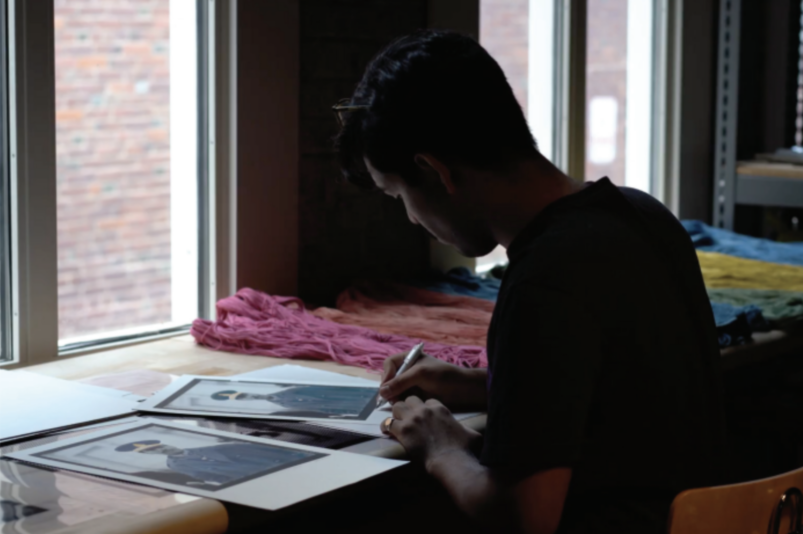
For Pilette and Yale’s other conservation experts, the Voynich testing was business as usual, and manuscripts with stories beyond and beneath the marks of their ink are nothing out of the ordinary. The conservation laboratory, with windows looking into the atrium-like Music Library, looks something like a high-school art classroom. There is a sink in one corner, a fume hood, and long yellow fluorescent lights in the ceiling. At a worktable covered with white butcher-paper, Sarah Dove sits with a large and apparently blank sheet of something that she is gently scraping with a small metal tool. Dove is a map specialist, and she is removing a damaging adhesive that was probably applied sometime in the 1970s. “You spend a lot of time looking at the reverse sides of things,” she explains. With the encouragement of her tool, the adhesive peels away from the back of the map the same way dry Elmer’s glue peels off of a kindergartener’s palm. The other side of the sheet is a map of Nova Scotia that was once part of George Washington’s personal map collection.

To a professional conservator like Dove, however, the map is a complicated interaction of paper, ink, and time. She sits quite straight, her forearm resting on the table, and works with deliberate, dispassionate precision. Her focus is not on Nova Scotia or George Washington, but on removing years of decay, wear, and negligence in order to restore the map to its original condition.

In this case, some of the map’s deterioration was actually caused by now-outdated preservation techniques. Today, most of the processes used to repair books can be reversed in case future conservators want to restore the book to its pre-repair condition. “Whatever we do could be undone without further damaging the material,” says Pilette. “You don’t know what future researchers might be looking for.”

For example, if a book’s spine is damaged beyond repair, Yale’s conservators can attach a new binding to the pages of the book with a reversible wheat starch adhesive. This means that they could easily remove the binding if it became damaged again or if a researcher were to think it necessary. “You can literally brush water on this and it will peel right off,” says Ian Bogus, holding a half-reconstructed book. As head of General Collections Conservation, he is responsible for protecting and restoring most of Yale’s collections. Some have been damaged through student abuse, but most have simply deteriorated over time. Besides constructing replacement bindings, Bogus’ and his assistants’ tasks include designing custom boxes to house more sensitive books. Each box must prevent its contents from warping or damaging under its own weight, so boxes are built to fit books’ lengths, widths, and heights almost as exactly as the green husk of a chestnut encases the fruit itself.

Some books, however, are beyond repair. These tomes, having reached the end of their lifespans, go down the hall to be reincarnated as text divorced from its original material self. While microfilming used to be the most common mode of reformatting, these days, a book’s pages are scanned and reprinted on more durable paper, or added to a growing digital database of book images. At his desk, surrounded by books with dusty and yellowing pages, reformatting specialist Gareth Gibson is busy digitizing issues of the Yale Daily News printed during the World War II era. He is ensuring that each article electronically links to its full continuation, and checking for completeness—not even an advertisement will be missing from the digital record. He once stumbled across a photograph a Yale student snapped of the Hindenburg zeppelin as it flew over the University on its way to its fateful crash. In general, however, if he starts to read whatever he is working on, Gibson says, “you just get swamped.”

Gibson and his colleagues in the Preservation Department are technicians and scientists, not researchers or historians. “A book is a mechanical object. Whatever you do affects how it will
operate in the future,” Pilette says. There is little content that could excite these conservators as much a certain antique ink called iron gall. Used widely in Europe starting in the medieval period, iron gall was usually a homemade ink, mixed according to family recipes that were already centuries old. An individual would prepare his or her own ink from wasps’ nests in oak trees, often distilling the ink with wine or beer. As a result, iron gall ink is unpredictable, highly acidic, and difficult for conservators to treat.

Christine McCarthy, the Yale conservation lab’s chief conservator, displays a “common-place book” written with iron gall and containing disorganized notes and records that crowd to the edges of each page. The title on record for this book is “Memoranda, historical notes, curiosities, and opinions on various subjects.” Sadly, the author’s reddish-brown scrawl has begun to bleed through the pages, as the acid in his homemade ink dissolves the paper on which he wrote. “There is no right answer for treating something like this,” McCarthy says.

Yet for all their technical expertise, good conservators need something more than chemistry and patience. Their work is “very artistic at times,” says E.C. Schroeder, who oversees all acquisitions, cataloguing, and preservation of materials at Beinecke Library. “It requires hand-eye coordination, good motor skills, and a sense of design and style—a sense of how to preserve the original.” The conservator must be sensitive to the thoughts and intentions of authors long dead, who survive only as names on the title-pages of the books they bound, but that sensitivity must also be matched by consideration of researchers and scholars in centuries to come, who will be the ultimate beneficiaries of the conservator’s work.


Dead Right

On November 8 in the Morse basement, mere blocks from where hundreds of Yale Democrats were celebrating Barack Obama’s presidential win after weeks of intensive canvassing and phone-banking, a small gathering of Yale College Republicans ruefully watched the blue votes pour in. Only one YCR member had canvassed during the months leading up to the election.

The YCR—Yale’s chapter of the Connecticut College Republicans— struggled to garner participation during the presidential campaigns, even when Yale’s generally left-leaning tendencies are taken into account. 12 percent of Yale undergrads, or about 650 students, described themselves as politically conservative in a recent Yale Daily News poll. This fall’s freshman bazaar yielded an initial YCR panlist of about 250 names, but only about 15 members regularly attended the weekly meetings leading up to the elections. The traditional forums for conservative voices—chiefly the Yale Political Union’s three right-leaning parties, the Yale Daily News’s editorial page, and the Yale Free Press—still exist, but their participants often show little interest in the YCR.

Conservatives at Yale, though a minority, are not a unified bloc. If the recent presidential elections are any indicator, many conservative Yalies don’t adhere to strict Republican Party lines. Matthew Shaffer DC ’10, a member of the Party of the Right and editor of the Yale Free Press, abstained from voting in November—a decision he now claims to regret—because he felt McCain was an “not an acceptable candidate.” Many members of the right-leaning YPU parties felt similarly. Though there are few crossover YCR-YPU members, Chris Pagliarella BK ’12, a self-described moderate Republican and member of the YCR board, is one such anomaly. Pagliarella, however, participates in the YPU through the Party of the Left and asserts that though a “significant minority” of the YPU’s three conservative parties voted for Obama, he was the only conservative member of a liberal party to have voted for McCain.

“It’s very difficult to get excited about the Republican Party today,” Shaffer says. He finds many aspects of the party’s platform at odds with his conservative mindset and laments a lack of intellectual
leaders on social issues such as gay marriage and the choice to enter an unpredictable war.

Jake McGuire PC ’10, also of the Party of the Right, critiques McCain’s selection of Sarah Palin as his vice-presidential candidate, saying he initially supported the Alaskan governor but grew to feel that “the Republican Party played too much to the populist base—and I think people here resent that.”

Other YCR board members refrain from criticizing Republican Party ideology, instead focusing their post-election analysis on specific policy issues. Trevor Wagener PC ’11, for instance, attributed much of the GOP’s loss to its immigration policy, which he believes alienated an important constituency of Hispanic voters. Other board members focus on Obama’s rhetorical choices, the media’s focus on Obama’s race, and the economic crisis as reasons for the Republicans’ loss.

One issue on which many Yale conservatives agree, however, is that the Republican Party—and, by extension, the YCR—is in bad shape. Current YCR President Tom Abell CC ’10 suggests the Republican Party form national coalitions that would appeal to fiscal conservatives who often vote Democrat, as well as to other strategic demographics.

Other Yalies see the need for a more drastic ideological shift. “It’s going to take a turn towards the intellectual side,” says Courtney Pannell MC ’11, a member of the YCR. “There is a big difference
between younger conservatives and our parents….We see how the party has to change: It has to be less monochromatic, less 1950s.” Pannell thinks that Republicans must retain their more traditional base while also reaching out to “the progressive, younger generation.”

Pannell’s suggestion reveals the desire for a revival of campus consevatism, an aspiration that is inexorably linked with iconic Eli William F. Buckley, Jr. In 1951, when Buckley published Man and God at Yale, a critique ofwhat he saw as Yale’s overarching liberalism, he identified an ideological void within the university community. Almost sixty years later, Yale conservatives feel a similar void not just on campus, but on the national political stage. They are waiting for their Barack Obama.


Coach Class

The Yale Bowl wasn’t always near-empty on Saturday afternoons. People didn’t always tailgate past half-time; in fact, the very first game of recognizable American football between two U.S. universities—Harvard and Yale—took place in New Haven in 1875. It was a Yale man, Walter Camp, who later became known as the “father of American football,” transforming a brutal form of rugby into a whole new game.

Looking at images of the Yale Bowl in the 1930s and ’40s, Professor Charles Hill says, one gets a sense of the centrality of Yale football games as social occasions and of the Yale Bowl as “where the most prominent people would want to be on a Saturday afternoon.” In those days, Hill says, playing football for Yale “was a test of manhood in America, and a pretty good guarantee of success in life.”

But Yale has changed. With the exception of 2006, Yale has lost every Harvard-Yale Game of the new millennium, and this is merely the latest slump in a long decline. Yale football has been unable to compete with the dazzling ascendency of the major Division 1 teams since the formation of the Ivy League in 1945 and its prohibition of athletic scholarships. Though Yale fielded a strong team during the 1960s, under the leadership of Coach Carm Cozza, the team’s national standing and student support have continued to fall. For the past two years, Yale’s losses to Harvard have been particularly brutal: 10-0 this year, 37-6 the year before. “Last year was a disappointment, I think everybody knows that,” says Ryan Fodor SY ’09, quarterback and graduating captain. “Going into every season, our goal should be to win an Ivy League Championship and beat Harvard.”

No one is more eager to make Fodor’s dream a reality than ex-student athlete, former pro-coach, and current Yale football messiah Tom Williams, who was appointed head coach this January. Williams is Yale’s third head coach in the last 44 years, and the first African-American to fill the position. He replaces Jack Siedlecki, who, after a fairly successful twelve-year tenure, announced his retirement following Yale’s shutout loss to Harvard in the 2008 Game.

With one infectious grin, Williams can fill a room with his enthusiasm for college football and the coaching profession. At a January 29 Master's Tea in Jonathan Edwards College, members of the Yale community had the chance to see him in the flesh. Along with a crush of reporters and football fans, I sat chewing cookies as Williams, resplendent in a beige suit and blue tie, eagerly outlined his vision for Yale football. His dapper mustache tilting up to the left as he smiled, he emphasized his commitment to his players as student athletes rather than pawns in an elaborate field strategy.

This focus on students aligns well with the ethos of the Ivy League Conference. With high academic requirements and no athletic scholarships, every football program in the Ancient Eight follows the same rules of recruiting. Having formerly coached at Pacific Ten Conference schools Stanford and the University of Washington, Williams is used to facing teams that are either “haves or have nots;” wealthy schools like USC, for example, are able to attract players with hefty scholarships and thus edge out their smaller rivals. The less competitive nature of the Ivy League approach, Williams explained, encourages a sense of shared mission, almost of family, among Ivy coaches. But to some team members, this is part of the problem.

When a player at the tea asked whether Yale stood a chance of gaining more national recognition, Williams replied, “We can win our conference, beat our rival, and be as good as we can. We’re not going to end up in the Championship. That’s not something we need to be able to do.” The player nodded, but without enthusiasm. The rules of the Ivy League Conference necessarily limit the scope of the Yale football program, making it almost impossible for the team to advance to playoffs. Fodor explained that there had been some interest among the players in pushing for a playoff opportunity, perhaps even a Bowl-style standoff. The downside, he said, would be diminished support for the Harvard-Yale Game, a cornerstone of Yale football tradition since the days of Walter Camp. And Williams, who’s placed beating Harvard at the top of his list of priorities, would be loath to do anything of the sort. Placing athletic competition in a larger perspective, he likened himself to any other professor, albeit one with a “classroom on the practice fields.”

Williams had only been on campus for a few weeks, but he greeted the players at his Master's Tea like old buddies. In the ante-room, a square-jawed guy in sweats transferred a slab of cake to his left hand so he and Williams could exchange a bro-shake. “This is one of those places that any college football coach would be interested in,” Williams said. “The prestige, the students Yale attracts—it’s a dream come true.” He wants to ensure that these students have a chance to contribute more to Yale than their football skills, so in order to give his players a chance to be more involved in student life, Williams plans on instituting early morning practices. If the players hit the field at 5:30 a.m., he reasoned, they’ll have time to go to Master’s Teas in the afternoons.


Back to Table of Contents