



Conservative Compassion

Global AIDS activists use Yale to prick the corporate conscience.


        By Daniel Kurtz-Phelan

 hen Sara Aviel talks about Botswana, her voice is burdened by bewilderment and helplessness. The Davenport junior spent last summer studying in the sub-Saharan African nation, which has a rate of hiv infection well above 30 percent—the highest in the world. But even as she rattles off death rates and recounts harrowing stories of her encounters with aids, she frequently stops, frustrated with her inability to express or confront the magnitude of the problem. “People I knew would go to funerals every weekend,” she remembers. “And even though they would never say that it was from aids—they always said it was tuberculosis or pneumonia or something—you just knew….”
After returning to Yale last fall, her sense of paralysis became a call to action. Aviel scoured the undergraduate community for a venue for international aids activism with little success. Finally she contacted the Center for Interdisciplinary Research on aids—only to find out that there were “no plans to be involved in any advocacy/activism work in Africa” and that the center’s “involvement in Africa is minimal at the moment.” It wasn’t until she read a January 28, 2001, article in The New York Times Magazine called “The World’s aids Crisis is Solvable: Look at Brazil”  that Aviel realized there was a viable avenue for action so close to home. “There was one line in the article about Yale owning the patent to an important aids drug,” she recalled. So she approached several professors to see if anyone knew anything about it, but again came up empty. And then the wave hit.
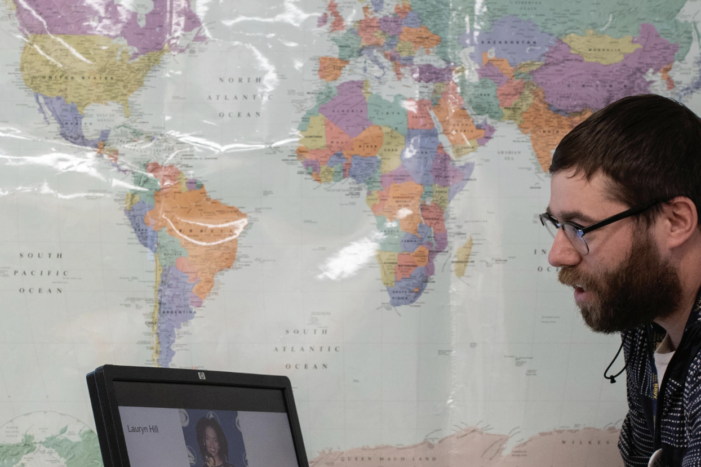
On February 20, Aviel received an e-mail from Marco Simons, a third-year Yale law student. The message was simple: Yale owned the patent for d4T, a critical and expensive antiretroviral medication which impedes the spread of hiv, and a group of students was organizing to put pressure on Yale to make the drug available at low-cost in South Africa. Simons had heard from a Harvard classmate-turned-aids activist, Toby Kasper, who works for the international medical aid organization Doctors Without Borders  (dwb) and was leading the charge to find a cheap source of d4T for South Africa. Kasper and his forces had already unsuccessfully appealed to Bristol-Myers Squibb, the Manhattan-based pharmaceutical giant to which Yale has exclusively licensed the production and sale of the drug. Now they were turning their attention to Yale itself.
Simons ended his e-mail with one small request: “For the moment, this is not for media consumption.” But less than a month later, the issue would be making headlines around the world, culminating on March 15 with a fulsomely congratulatory announcement by The New York Times, “Maker Yielding Patent in Africa for aids Drug.”

4T, or stavudine, constitutes one-third of a drug cocktail that has proven remarkably successful in treating hiv-positive patients. The compound is an antiretroviral, meaning it prevents hiv from reproducing and delays the onset of aids, thereby allowing patients to survive for decades after contracting the virus. Though it was first synthesized in a cancer study at the University of Michigan in the 1960s, interest in d4T was not renewed until the global aids epidemic flared up in the 1980s. In 1986, two Yale doctors, William Prusoff and Tai-shun Lin, received several million dollars of funding from the National Institutes of Health and other sources—Bristol-Myers among them—to  investigate whether the compound could be used in combating hiv. When experiments in Yale pharmacology labs proved successful, the University quickly patented the compound and sought out a pharmaceutical company to take care of the development, marketing, and distribution of the drug. Bristol-Myers had “right of first refusal” because of its help funding the project, and, naturally, the company jumped at the opportunity.
In 1994, d4T hit the shelves under the brand name Zerit. us newspapers praised the low cost of the new drug, which would be offered at $6 a day. But this still meant that a year’s supply of  Zerit would cost almost $2000, more than the per capita income of almost every African nation.
The high price of aids drugs in the developing world has elicited considerable international attention—and frequent outrage—in the past two years. Emotionally charged articles in publications from The Economist to Mother Jones have highlighted the difficulties of treating aids in poor countries. International ngos have called on the developed world to help provide treatment for hiv-positive patients who can’t afford the $15,000-a-year drug regimen required to slow the spread of the virus and the onset of aids. The aids activism group act-up headed a widely publicized campaign of civil disobedience at every one of Al Gore’s presidential campaign stops until he agreed that—contrary to previous statements in which he had toed the pharmaceutical company line—there is an urgent need for low-cost aids drugs in Africa. And, most forebodingly for pharmaceutical companies, Brazil and India were often pointed to as models of how the developing world could deal with the crisis: by ignoring patents and allowing cheap generic production of medications.
South Africa has been a focal point in the struggle for affordable aids medication. Not only does it have more cases of hiv than any other country, but, unlike most of sub-Saharan Africa, it has both a strong patent protection system and sufficient domestic infrastructure to develop its own pharmaceutical manufacturing if patents allow it—making South Africa a battlefront for corporations and ngos. Toby Kasper coordinates dwb’s “Access to Essential Medicines Campaign” in South Africa and has emerged as the spokesman and de facto leader of the mix of activists, officials, and aids patients fighting for drug availability. Last fall, Kasper picked out Bristol-Myers as a target. He sought to convince the company to voluntarily give up their rights to d4T in South Africa in order to allow for inexpensive generic production, knowing the effort was
quixotic. “Drug companies have always tried to protect their patents to the bone,” he acknowledged. The company’s profits on the drug exceed $600 million annually, and there had never before been a case where a pharmaceutical company had given up such a lucrative drug in a protected market like South Africa. In fact, Bristol-Myers is one of 39 international drug-makers currently suing the South African government for more stringent patent protection—despite the fact that sales of d4T in the country are virtually nil.
But d4T was a special case: A university, not a corporation, had the patent. After a stream of letters from dwb beginning last November, Bristol-Myers passed the buck to Yale, which itself profits some $40 million a year from the drug.  So Kasper called up his friends in New Haven, sent a letter to the University, and set out to persuade, pressure, or shame Yale into giving up the rights to d4T in South Africa.

ike Aviel, Amy Kapczynski, a first-year law student, hadn’t done much in the way of aids activism at Yale before the movement for patent relief shifted its focus towards the University. But in the past few years, she has worked for an international aids consortium in England and did research for a “60 Minutes” documentary on aids in Africa, which sent her to a conference in Durbin, South Africa, last summer. There, she learned about her future school’s ownership of the d4T patent and met Toby Kasper. When Kasper and dwb—which won the Nobel Peace Prize in 1999—set their sights on Yale in January, Kapczyski and Simons were the first people contacted.
Kapczynski, who was described by a colleague as having “a radical inside combined with a very rational sense of how to get things done,” recognized a unique opportunity with far-reaching implications. “Up to now,” she said, “it’s been activists fighting on the ground and big corporations making concessions.” But in this case, the object of pressure was a university rather than a corporation, and for Kapczynski, Kasper, and their small squadron of activists, this was an essential difference. “Universities are a good point of leverage,” Kapczynski remarked. “They are an important pressure point, in part because they have student bodies that care about these things.” And, as Kasper did not hesitate to point out to Yale, the University has a stated objective in patents and licensing to “pursue the benefit of society in general.”
So, the campaign was initially kept quiet and private, reflecting Simons’s belief that “with University politics things tend to get done better behind closed doors than in the midst of big public campaigns.” Instead of approaching Yale as they would a corporation, the coalition treated it as a potential associate. “No one considered the University an adversary, but really more of a cautious partner,” Aviel said. “And it was our job to capitalize on this partnership.”
In February of this year, all currents of the movement were coming together, and the point of their convergence was Yale. dwb had focused its private and public efforts on the University; the issue of patents and aids drugs was making the national editorial pages; and a small but informed coalition of students began pleading the case to administrators, building an alliance with aid workers and patients who rely on d4T, and directing international momentum into key channels. “I don’t think we can take credit for making this happen,” said Aviel. “It was definitely global momentum that we directed a little closer to home. We rode the wave of activists around the world.”

n February 14, dwb wrote a letter to Jon Soderstrom, the Managing Director of the Office for Cooperative Research (ocr), which oversees patenting and licensing for University studies. The letter called for Yale to issue dwb a “voluntary license” so that it could obtain generic drugs for distribution in South Africa. That day, Kasper sent another letter to Bristol-Myers asking the company to support this request. The Yale students also wrote to University officials and issued a request, which was denied, for a copy of the Bristol-Myers licensing agreement. Meanwhile, they were gearing up to intensify pressure on Soderstrom, whom they expected would not initially grant Kasper’s request.
The effort received a boost when Cipla, an Indian pharmaceutical firm, announced that it would produce a generic version of d4T and sell it at a remarkable 1.5 percent of the cost of Zerit. Thus, when Yale did respond to dwb on February 28—claiming, according to Kasper, “that they couldn’t do anything” because of their exclusive license with Bristol-Myers—the issue was no longer quiet. The day before, Kasper and other representatives of dwb had visited Yale, issuing a public challenge to the University for the first time.
From this point until the March 14 announcement by Bristol-Myers, exactly what transpired between the University nd the pharmaceutical company is confined to speculation. Kapczynski called the negotiations “a murky procession of events.” The public request by dwb elicited a tentative endorsement from Dr. Prusoff, who still does pharmacology research at Yale. “This was not something I’ve worried about before,” Prusoff admitted. “But the problem was clearly presented.” On March 9, dwb sent a second letter to Soderstrom. The message, according to Kasper, was simple: “If you are following your own licensing policy, you should do something about d4T prices in South Africa.” In an appeal to the OCR’s profit-making focus, the letter also pointed out that Yale had almost nothing to lose financially in granting a voluntary license for d4T.
The issue had also been picked up by GESO, Yale’s incipient graduate student union, after Fran Balamuth, an MD/PHD student in immunobiology, brought the issue to the attention of the coordinating committee. For her, the controversy was about researchers’ rights. “D4T is intimately connected with what [GESO is] fighting for,” she maintained. “For a long time, geso’s been talking about the role of corporations in determining research and where it goes.” The union created a petition calling for the release of the d4T patent in South Africa and mobilized its sprawling grassroots network. Within a matter of days, Balamuth and others had collected over 600 signatures—including one from Prusoff, the drug’s inventor. However, contrary to the accounts of geso activists, Soderstrom claims he never actually saw the petition until after the decision was made.
As both the public and private campaigns continued, Soderstrom remained quiet. For the students and dwb, this seemed a sign of dubious activity on the part of Yale and Bristol-Myers. Kapczynski and Simons were prepared to escalate public pressure when the student body returned to campus after spring break. At this point, another international event raised the bar for Bristol-Myers and Yale: The drug manufacturer Merck announced that it would sell its aids drugs at cost in South Africa. This was unknown territory for the industry, but once it had made the step, it could only move forward.
Public pressure reached a critical point on March 12 when The New York Times printed an article on Yale’s unwillingness to relax the d4T patent in South Africa. Even Prusoff, who remains one of Yale’s most reliable supporters on this issue and who shares in the pharmaceutical company’s profits from d4T, points to the public relations nightmare conjured up by the article. “The most important thing was when The New York Times picked up that article and brought that forward,” he speculated. “I think that was a major factor in stimulating discussion between the Yale administrators and Bristol-Myers.” Kasper agrees with this appraisal. “There was the article, and voila, things worked out. I don’t think it was just coincidence.”
Soderstrom, however, maintains that these external factors had little persuasive effect. “Bristol-Myers was correct in saying that there were certain things they couldn’t do without our permission,” he said. “Both they and the University moved at light-speed to make this change.” And as to criticisms that Yale refused to ever make publicly available the discussion with Bristol-Meyers and the contract itself? Soderstrom defends the decision as typical business policy. “The fact that we don’t negotiate things like this in public says that’s not the way you get things done in corporations. We didn’t have all the answers, and we needed time to talk to Bristol-Myers. We weren’t forced to do anything we didn’t want to do.” Yale and Bristol-Myers were simply “moving at the speed of business,” and in mid-March, the process proved fruitful.

On March 14, Yale and Bristol-Myers Squibb issued simultaneous press releases: The University, expressing its pride at having “helped prolong the lives of so many who suffer from aids,” said that it had removed all obstacles preventing Bristol-Myers from making d4T available at low cost in South Africa; Bristol-Myers, for its part, announced that it would make Zerit and Videx, another aids medicine, available below cost in African countries, and that it would not try to prevent cheaper generic versions of the drugs from being produced, imported, and sold in South Africa. “The company,” the announcement proudly proclaimed, “has no other patent rights in Africa which it will allow to prevent aids therapy there.”
Headlines around the world cheered the unprecedented move, lauding both the University and Bristol-Myers. Yale enthusiastically patted the company on the back. “Bristol-Myers came up with a more comprehensive and far-reaching solution than any other pharmaceutical company,” said Soderstrom. “This is unprecedented change, and they should be applauded for that.” In this age of compassionate conseratism, the d4T announcement was the perfect plug: industry, government, ngo, and academy working together and ignoring self-interest to find a humanitarian solution to an international problem. And Yale and Bristol-Myers had emerged from the fray with no sign of injury: Neither had actually forfeited anything in the way of profits, they had avoided a potential pr debacle, and, in the process, they had taken the issue away from the activist community. In a March 19 op-ed in The New York Times, Dr. Prusoff concluded, “I find it hard to see any pattern in all this, except perhaps that there is a moral urge among people that, however coincidentally, can sometimes bring results.”
At Yale, meanwhile, student interest in the issue was coming to a peak. Kapczynski, Simons, Aviel, and a number of other students planned a “teach-in” to educate beyond the headlines. On April 2, over 250 students, professors, and other members of the community crowded into a room in Linsly-Chittenden Hall. The speakers represented every element of the struggle that had led to the Yale-Bristol-Myers decision. Kasper spoke on the pandemic in Africa, highlighting the need for affordable medicine. hiv-positive South African activists added a personal note. Asia Russell, who works for act-up Philadelphia, accused the us of “driving a coalition which was actually killing people with aids” and denounced this “state-sanctioned genocide,” proclaiming, “They did this because we demanded it.” Balamuth discussed Yale’s patenting and licensing policy, calling for a greater role for researchers in such decisions, and highlighting geso’s commitment to the issue. Kapczynski matter-of-factly described the negotiations process. The lefty crowd, arriving late from the most recent anti-Free Trade Area of the Americas protest, extended an open invitation to the aids activists to join them on a trip to Quebec City for the April 20 anti-globalization protest. There was a dizzying array of “actions” to take, websites to consult, lists to sign, and people to contact. But even as the offshoots of the original campaign multiplied, those initially involved were not sure what their next step should be.

n the month since Yale and Bristol-Myers made their announcement, the effects have rippled. Yale has pledged its continued commitment to improving access to aids treatment in Africa: At an open forum in early April, President Richard Levin called for “a significant effort by Yale to help train people to administer [d4T] in Africa” and claimed, “I’m very committed to this.” geso has kicked off an effort to give researchers more voice in how their discoveries are patented and licensed. Student radicals have added access to aids medicine to their agenda. The media’s fascination with aids in Africa has become, if anything, more intense; a recent lead article in The New York Times highlighted the continued problem of access to essential medicines, issuing an implicit call to sustained action. Students at other major universities—most notably the University of Minnesota, which licenses the patent for another important aids drug to GlaxoSmithKline—have taken up the sort of fight first seen at Yale last month. And in early April, at the behest of un Secretary General Kofi Annan, six major pharmaceutical firms—Bristol-Myers Squibb, GlaxoSmithKline, Pfizer, Abbott, Hoffman-Laroche, and Boehringer Ingelheim—declared their commitment to lowering prices and making aids drugs more widely available and affordable in the neediest portions of the developing world.
But the people who hastened the change at Yale are cautious in their celebration. In fact, at this point, they are not even sure what the decision meant. “We don’t know what the outcome is,” Kapczynski admitted. The ocr has only said that it amended the licensing agreement with Bristol-Myers. “An exclusive license ensures that a company is diligent in marketing a product and doesn’t just put it on the shelf,” Soderstrom explained. “In order to do this, certain restrictions are put on the agreement—we had to remove those restrictions.” Bristol-Myers, in addition to offering drugs to unaids and the World Health Organization at a reduced (but still far higher than generics) cost, has merely pledged not to fight back if the patent is violated. “This is a big step forward and it has a lot of possibility,” Kasper said. “But drug companies often make very grandiose announcements and don’t do anything on the ground.”
For the moment, Kapczynski, Simons, Aviel, and other concerned students are taking minor steps and doing their best to get their bearings. They are examining “the systematic problem of research being so closely tied to corporate interests”, convening a forum (with some coaxing by the dean of the law school) to educate themselves on how the licensing process works, and in the preliminary stages of creating some sort of University-wide aids coalition. Still, Aviel said, “None of us know exactly how this works or where it’s going.” And Kapczynski warned, “A lot of fortuitious things worked together to make this successful, but the more this becomes replicable, the more resistance there will be.”
Amy Kapczysnki, Marco Simons, and Sara Aviel alighted on a wave of international momentum and directed it closer to home. Now, the wave is mostly past them. But they all realize that “on the ground” nothing yet has been gained. And though all of this started on the ground, no one  knows if that’s where it will end.


Daniel Kurtz-Phelan, a sophpomore in Berkeley College, is a managing editor for TNJ.