Yale University.
Calendar. Directories.


The Internship


Yale Farm Summer Internship

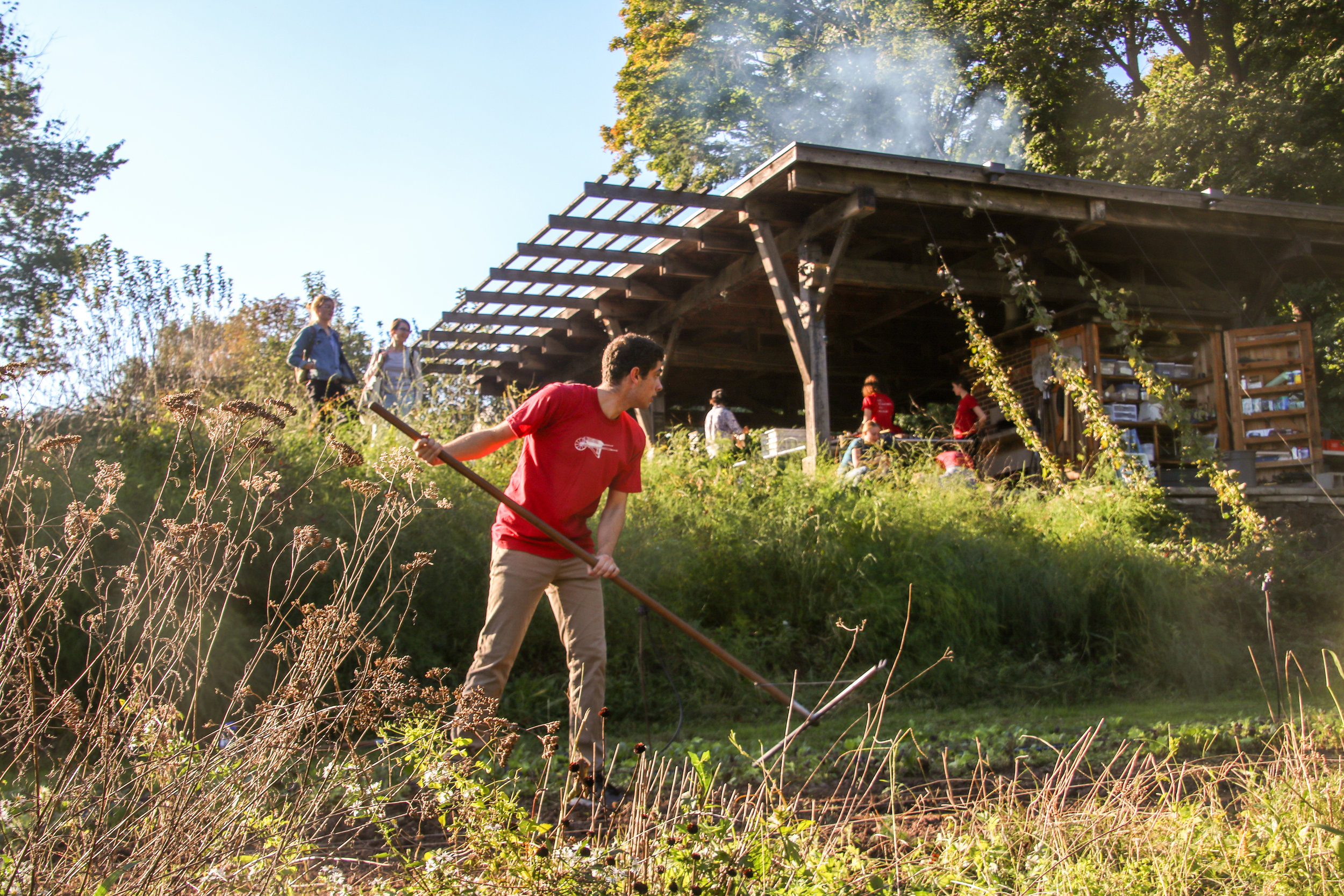
The Yale Farm summer internship offers six Yale undergraduates the opportunity to gain hands-on experience in sustainable agriculture and local food systems. Interns participate in farm work, weekly classes, visits to local farms, and regional conferences. These students experience the direct link between land and food with daily meals prepared from and shared at the farm, and they connect with the New Haven community by selling produce at the Wooster Square farmers' market. Each year, students leave the internship ready to assume leadership roles at the Yale Sustainable Food Project and in the sustainable food movement on campus.


Applications for the 2012 internship are no longer being accepted. Please check back in the spring of 2013 for information about the 2013 season.


If you have questions about the program, please send a note to sustainablefoodproject@yale.edu.


  • "That summer I got to know a square acre of land very, very well. I learned that a potato is the stem and not the root of the plant, that tomatillos grow their paper lantern exterior before their actual fruit, and so much more. The education I'd have a harder time describing, though, is the Yale Farm's syllabus. How spending eight hours a day with my hands in the earth, laughing and learning with five dear friends, healthier than we ever were during the school year, and growing food to sell and donate to people all over New Haven, had changed all of us." Nozlee Samadzadeh, Morse '10, Computing and the Arts
  • "Farming taught me to think in a different way. Really, it taught me to pay attention. Only by concentrating on the work I was doing -- paying close attention to my hands, noticing colors, textures, smells -- could I do my work well. It's the same concentration you need to read a book well, but with an immediacy and fullness of sensation that can only be found by working with both your body and your mind." Laura Blake, Jonathan Edwards '12, American Studies
  • “There was a pervasive sense among the interns that we were doing something good for ourselves and others.” Joe Hunt, Jonathan Edwards ’07, Political Science
  • “The things I have not, and cannot, learn inside a classroom are both numerous and vital—they are things I could only have come to bit by bit, returning to work the same small piece of land day in and day out, connecting consciously with earth and growth and sustenance. That is what this summer has been about, for me: moving away from the specific, tightly focused world of the classroom and into one that is both larger and more full, more lushly variegated, but which still demands of me all that I am capable of giving it.” Zan Romanoff, Branford ’09, Literature
  • “I wanted to gain a substantial level of knowledge and experience in sustainable agriculture and to spend a summer outside doing physically rigorous work.  The attraction was at once both romantic and intellectual.” Dan Sussman, Trumbull ’07, American Studies
  • “I can’t pinpoint exactly how this internship has inspired this wild devotion: maybe visiting other farms, and speaking with farmers at the farmers’ market; maybe rooting my hands into the soil, weeding, or raking beds; maybe bringing home big bushels of vegetables and spreading them out onto the table, and then just eyeing them, breathing them in, wild with ideas about how to cook them for dinner. Maybe just living food, as I have, six days a week, this whole summer. It’s been something; my friends have noticed the change. They say I’ve become more grounded. I don’t agree­—I think I’ve gone mad, for being so silly about food­—but I understand what they mean. I have a vision now.” Gordon Jenkins, Jonathan Edwards ’07, Literature
  • “Over the summer I spent as a farm intern, I built up a store of well being, which carried me through the semester that followed. Three and a half months of laboring outdoors in the sun and the dirt, growing good food and eating it, left me healthy, well-fed, and profoundly satisfied. Shored up both physically and mentally by the work of farming, I was able to withstand four months of persistently late nights and little rest. I can find extraordinary pleasure in crafting a well-turned phrase or solving a design problem. But the pleasure I found in the good, hard work of farming was complete and abiding. Like the tomatoes we picked and preserved in August, and ate in January, it lasted long past the harvest. It lasts still." Anya Kaplan Seem, Jonathan Edwards ’08, Architechture
   
"));