






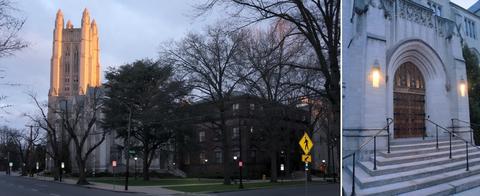

The Psychology Department organizes itself into
five
programs
representing the major substantive domains of psychology at Yale.
Weekly seminars for faculty and students are offered in each of these
programs.
Behavioral
Neuroscience
A course of study in Behavioral Neuroscience emphasizes an
understanding of the basic mechanisms of behavior through the knowledge
of their physiological substrates, and an appreciation of their varying
or similar forms in different organisms. A major concentration of
faculty interest is in the psychobiology of learning and memory.
Approaches to this general question include abstract theoretical models
(e.g., in animal learning), integrative physiological investigation
(e.g., in the role of specific neural structures, such as the
cerebellum and brain stem nuclei, in learning), cellular and
biophysical analyses in simple systems (e.g., in invertebrate animals
and hippocampal slice), and computational approaches (e.g., utilizing
models of adaptive neural networks). Other current foci of faculty
interest are in the neural bases of cognition, motivational processes,
and psychopharmacology.
Training in Behavioral Neuroscience is generally integrated with study
in related areas within the Psychology Department and enriched by
affiliation with other Yale departments and associated research
centers. For example, students with a special interest in the learning
process may avail themselves of the extensive course offerings in human
memory and information processing in the Psychology Department.
Students may also pursue relevant courses and research experience with
cooperating faculty in the Yale Neuroscience Program. This program
represents a cooperative effort among the following academic units:
Anesthesiology, Biology, Cell Biology, Cellular and Molecular
Physiology, Computer Science, Genetics, Neurobiology,
Neuroendocrinology, Neurology, Neuropathology, Neurosurgery, Obstetrics
and Gynecology, Ophthalmology and Visual Sciences, Pediatrics and
Respiratory Medicine, Pharmacology, Psychiatry, Psychology, and
Surgery. The Neuroscience Program admits its own Ph.D. candidates, but
graduate students for a Psychology Ph.D. are able to participate in any
of the course offerings available in the Neuroscience Program.
Additional course or research opportunities are available from the John
B. Pierce Foundation, the West Haven VA Medical Center, and the
Department of Psychiatry. All Behavioral Neuroscience faculty and
graduate students, occasionally joined by visiting scholars, meet
weekly to discuss current and ongoing research.
Clinical
Psychology
The Clinical Psychology Graduate Program at Yale University is a member
of The Academy of Psychological Clinical Science, which is a coalition
of doctoral training programs that share a common goal of producing and
applying scientific knowledge to the assessment, understanding, and
amelioration of human problems. Membership in the Academy is granted
only after a thorough peer review process. Its membership in the
Academy indicates that the Clinical Psychology Graduate Program at Yale
University is committed to excellence in scientific training, and to
using clinical science as the foundation for designing, implementing,
and evaluating assessment and intervention procedures.
The Clinical program is fully APA accredited based on periodic review
by the Committee on Accreditation (CoA), with the next program review
scheduled for 2008. Contact information for the CoA is provided below.
Committee on Accreditation
American Psychological Association
750 First Street, N.E.
Washington D.C. 20002-4242
Phone (202) 336-5979
Our program is committed to a model of clinical psychology education
designed for the scientist-professional. The mission of the Clinical
Psychology Program at Yale is to educate the next generation of leading
academic and research psychologists and to create an environment for
advancing theory and research for both students and faculty. Within
this context, clinical training is designed to help students
investigate theoretically important and clinically relevant questions.
We emphasize integration of research and clinical work to develop
innovators who will advance the theoretical and empirical bases of
knowledge in clinical psychology. Although we do not have specific
tracks because of the relatively small size of the program (e.g. adult,
child, health), opportunities are available for students to gain
research and clinical experience with both adults and children. Rather
than having specific tracks, students develop their own unique programs
of study that meet general departmental standards and fulfill
requirements that will enable them to obtain appropriate internships
and to sit for state licensing examinations. Participation in faculty
research and development of personal research and scholarly studies are
key features of scientific training. Professional skills are developed
through course work and direct involvement in clinical assessment,
psychotherapy, and other methods of intervention (e.g. prevention,
advocacy). Practicum training is available in the Yale Anxiety and Mood
Service (YAMS) and the Yale Parenting Center and Child Conduct Clinic
as well as in other settings in the Yale community including the Yale
New-Haven Psychiatric Hospital, the West Haven VA, the Yale Child Study
Center, and the Connecticut Mental Health Center. Weekly luncheon
meetings in which students, faculty, or visitors present clinical
research are held throughout the academic year.
Cognitive
Psychology
The program in Cognitive Psychology is concerned with basic research in
perception, human learning and memory, consciousness, thinking and
problem solving, language, and intelligence, as well as with
applications of this basic research to everyday settings. Much of the
research in the cognitive group bridges across these various fields of
specialization. In addition to the core faculty in Cognitive
Psychology, many faculty members with other primary specializations are
also interested in cognitive research. Students are encouraged to read
widely both in the cognitive area and in related disciplines, such as
computer science, linguistics, philosophy, and statistics. Programs of
study overlapping with other areas of psychological research such as
developmental, social, clinical or behavioral neuroscience, are
encouraged. The cognitive group meets together as a whole every Tuesday
for a presentation (with discussion) by one of its members, and
numerous smaller groups with special interests also meet on a regular
basis for internal exchanges of ideas. Students are encouraged to study
and do research with multiple faculty members, and to develop their own
program of research in an area of their choosing. The Cognitive
Psychology group is highly interactive and encourages research and
discussion representing diverse viewpoints within the field.
Abilities and Expertise The graduate program in abilities and expertise
in the Department of Psychology at Yale University is designed to teach
students about the nature of abilities, expertise, and their
interrelations. The program considers a number of factors that lead to
the development of abilities and expertise, such as learning and
memory, intelligence, creativity, wisdom, personality, motivation,
styles of thinking, and social-situational factors. It is
multidisciplinary in its approach, considering biological, cognitive,
developmental, educational, psychometric, and social-psychological as
well as other approaches to the topics it studies. Students
participating in this program will also be affiliated with at least one
of the other areas of the department: behavioral neuroscience, clinical
psychology, cognitive psychology, developmental psychology, or social
psychology. The program draws upon faculty and students with diverse
interests, and encompasses a wide-ranging set of courses and research
programs.
Developmental
Psychology
The Developmental program offers advanced training in understanding
children of all ages. Instruction is available within the Department of
Psychology and with other scholars in other areas of the University.
Topics of special interest to developmental faculty and students
include infancy, adolescence, cognitive development, applications of
developmental psychology to education, developmental psychopathology,
social policy, intelligence, language and thought, and children in
other cultures.
The heart of the program is direct involvement in research: First term
developmental graduate students begin to work with student and faculty
colleagues in the exploration and systematic study of problems involved
with the rich variety of child behavior.
Courses are offered by all members of the core faculty. Our basic
meeting is the weekly lunch where faculty, students, and visitors
present their research and their plans for future investigations.
Students also are encouraged to enroll in courses or to work with
faculty members specializing in social and personality,
neurobiological, and cognitive aspects of development. Developmental
students also will benefit from contact with the faculties of
Pediatrics, the Child Study Center, the Bush Center in Child
Development and Social Policy, and Haskins Laboratories.
Social/Personality
Psychology
The Social/Personality Psychology program at Yale University has
trained research scholars for more than sixty years. Under the
influence of Carl Hovland in the 1940's and 1950's, the Yale program
was concerned primarily with persuasion and attitude change. This group
of psychologists, some of whom continue to be active in the Department
even today, set the course for the Yale program through their
investigation of problems such as the links between frustration and
aggression, public opinion formation, and the cognitive basis of social
behavior. During these years and the decades that followed, the program
remained committed to training students interested in both
laboratory-based methods as well as field research. The
Social/Personality program has focused on advancing both basic
knowledge about intrapersonal and interpersonal processes, while at the
same time encouraging applications of these theoretically driven
investigations.
Since its inception, the character of the Social/Personality program
has been unique in combining four training goals. First, we believe
that training students in scientific fundamentals is the most effective
way to influence progress in the field of psychology. Second, in
addition to a strong emphasis on traditional laboratory experiments as
the primary tool of the Social/Personality psychologist, the training
focus has also encompassed diverse methodologies such as field
experimentation, survey techniques, computer simulation, and case
studies (where the "case" might be an individual, group, or
organization). Third, the program attempts to foster an awareness among
students of the use of applied contexts to test theoretically based
ideas. Finally, the faculty in Social/Personality Psychology is
committed to an integration of personality processes and interpersonal
influences in the study of human behavior. We believe that meaningful
analyses of human behavior can best be accomplished when researchers
investigate interactions between intrapersonal processes (e.g.,
emotion, social cognition, motivation, attitudes, and belief systems)
and social behavior (e.g., persuasion, communication, decision making,
stereotyping, political behavior, health behavior, and intergroup
cooperation or conflict).
We believe that young investigators are best trained by a program
emphasizing carefully supervised independent research with one or more
members of the faculty. Although students receive classroom training in
the essentials of general psychology theory, research methods, history,
and the current literature, they are encouraged from their first days
at Yale to develop a program of collaborative research with members of
the faculty. There are only a few course requirements, and students are
expected to construct a program consistent with their own research
interests that includes elective courses in other areas of psychology
and in other social science fields. The Social/Personality area meets
as a group every Monday for research presentations and discussion.
Individuals interested in specific areas of specialization such as
political psychology, health psychology, emotion, or social cognition
can attend additional weekly meetings of like-minded faculty and
students. |