









Yoram Alhassid

Professor of Physics, Yale University

Phone: 203-432-6922; Email: yoram.alhassid@yale.edu

Nuclear Many Body Theory and Mesoscopic Quantum Dots

Yoram Alhassid is working at the interface of the nuclear many-body problem and statistical mechanics. His studies address the properties of nuclei under extreme conditions such as high excitation energies and high angular momentum. The understanding of these properties is important in various astrophysical problems as well as in tests of fundamental symmetries. Conventional diagonalization methods of the nuclear Hamiltonian become intractable for such nuclei. Alhassid and collaborators have devised macroscopic and microscopic approaches that cirvumvent this problem. The macroscopic approach is based on the Landau theory of symmetry-breaking phase transitions. He applied this theory to the giant dipole resonance in hot nuclei and predicted that this dipole radiation can be used as signature for certain shape transitions [6]. In the microscopic approach, Alhassid and collaborators are developing quantum Monte Carlo methods to solve exactly the strongly interacting nuclear system at finite temperature. Applications of such methods had been limited because of the "sign" problem which is generic to all fermiomic Monte Carlo methods. Their practical solution to this problem [7] opened the door to realistic calculations in configuration spaces that are larger by many orders of magnitude than any model spaces treated by conventional methods. Applications include the first microscopic evidence of softness in heavy nuclei [8], and the first fully microscopic calculations of level densities [9] and other nuclear properties relevant to astrophysics.

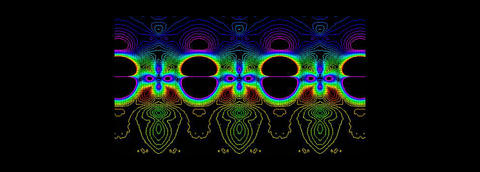
Another major research interest of Alhassid is the area of mesocopic physics. Recent advances in materials science have made possible the fabrication of small devices, known as quantum dots, in which a small number of electrons is confined to a region whose typical size is less than a micron. Since quantum dots can be connected to leads in order to measure their transport properties (conductance). The interest in these devices from the fact that the electron phase is preserved over distances that are large compared with; the system's size, leading to new phenomena not observed in macroscopic conductors. In dots with little disorder the electron dynamics is dominated by scattering from the boundary. Because of irregularities in the dot's shape, this dynamics is chaotic. Alhassid and collaborators developed a statistical theory for such quantum dots [10,11] which explains the mescoscopic fluctuations of the conductance in terms of the underlying signatures of chaos in the electronic wavefunction. The fluctuations of the conductance show similarities to those of the neutron resonance widths in the compound nucleus. A fascinating problem of current interest is the interplay between one-body chaos and many-body interactions in quantum dots.

References:

[6] "The Giant Dipole Resonance in Hot Rotating Nuclei," Y. Alhassid, Nucl. Phy. A 569, 37c (1994).

[7] "Practical Solution to the Monte Carlo Sign Problem: Realistic Calculations of   54 Fe," Y. Alhassid, D.J Dean, S.E. Koonin, G. Lang and W.E. Ormand, Phys. Rev. Lett. 72, 613 (1994).

[8] "Shell Model Monte Carlo Studies of gamma-Soft Nuclei," Y. Alhassid, G.F. Bertsch, D.J. Dean and S.E. Koonin, Phys. Rev. Lett. 77, 1444 (1996).

[9] "Total and Parity-Projected Level Densities Ion-Region Nuclei in the Auxiliary Fields Monte Carlo Shell Model," H. Nakada and Y. Alhassid, Phys. Rev. Lett. 79, 2939 (1997); Phys. Lett. B. 436, 231 (1998).

[10]  "Statistical Theory of Coulomb Blockade Oscillations: Quantum Chaos in Quantum Dots," R. A. Jalabert, A. D. Stone and Y. Alhassid, Phys. Rev. Lett. 68, 3468 (1992).

[11] "Universal Parametric Correlations of Conductance Peaks in Quantum Dots," Y. Alhassid and H. Attias, Phys. Rev. Lett. 76, 1711 (1996);  "Weak Localization in the Conductance Peaks of Coulomb Blockade Quantum Dots," Y. Alhassid, Rapid Communication, Phys. Rev. B 58, R 13383  (1996).

[12] "Non-equilibrium Steady States and Transport in Theory," preprint, (1999).

[13] "Quantum Levy Processes and Fractional Kinetics", Phys. Rev. Lett., 82 (1999) 1136.

[14] "Incompleteness of Represntational Theory: Hidden Symmetries and Quantum Non-integrability," Phys. Rev. Lett. 79  (1997) 537.

[15] "Radiative Decays of  QQ  Mesons," F. Iachello, D. Kusnezov, Phys. Rev. D45, 4156 (1992).

[16] "Scaling Properties of the Giant Dipole Resonance Width Within Hot Rotating Nuclei," D. Kusnezov, Y. Alhassid and K. Snover, Phys. Rev. Lett. 81, 542 (1998).