Institutions, public participation and environmental sustainability: Bridging research and capacity development
May 10-11, 2008, Yale University, New Haven


  yale

unitar

Yale Center for
Environmental Law & Policy
301 Prospect Street
New Haven, CT 06511

United Nations Institute for
Training and Research
(UNITAR)
Palais des Nations
1211 Geneva 10
Switzerland

+1  203.436.4938 (tel)
+1  203 432.0237(fax)
envdem@yale.edu

www.yale.edu/envirocenter/unitar.htm
www.unitar.org/egd


UNITAR-Yale Conference on Environmental Governance and Democracy Reveals Deficits in the Understanding of the Democracy - Environment Interface

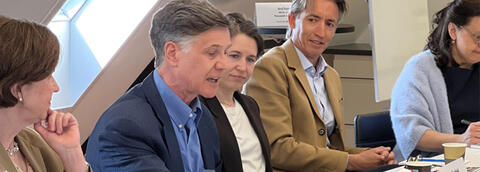
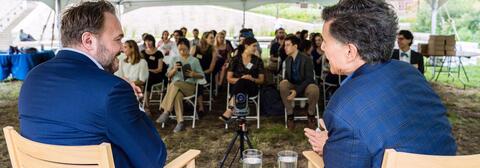
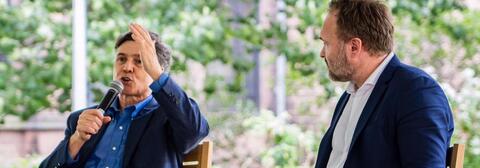
How can democratic institutions and processes be designed so that they are compatible with, and foster environmental sustainability? This question was at the centre of discussion at the UNITAR-Yale Conference on Environment and Democracy, 10-11 May 2008 at Yale University, New Haven, Connecticut. “Democratic participation in environmental governance has become an internationally agreed principle” said Carlos Lopes, Executive Director of UNITAR and Assistant Secretary General of the United Nations in his introductory remarks, “but it is the socio-economic context and local capacities which essentially determine how civic participation can effectively contribute to good governance and environmental sustainability.”

The Conference took place in the margins of the 16th Session of the United Nations Commission on Sustainable Development (CSD) and was jointly organized by Yale University and the United Nations Institute for Training and Research (UNITAR), in partnership with the United Nations Economic Commission for Europe (UNECE), the University of Cape Town, the French Institute of Forestry, Agricultural and Environmental Engineering (ENGREF-AgroParisTech), the World Resources Institute (WRI), and the Stakeholder Forum for a Sustainable Future. The event brought together some 150 academic scholars and practitioners from governments, inter-governmental organizations, and civil society from around the world.

Participants took stock of contemporary research and identified knowledge gaps at the intersection of democratic institutions and environmental sustainability. Discussions addressed various levels of environmental governance, including international, national, sub-national, local and corporate governance. Public participation in international environmental governance received specific attention throughout the discussions. Speaking to this theme, Gus Speth, Dean of the Yale School of Forestry and Environmental Studies and former Administrator of the United Nations Development Programme (UNDP) observed that “while civil society frequently enjoys participation opportunities in national and local level processes, mechanisms for meaningful stakeholder engagement at the international level, as well as knowledge about their effectiveness is  lacking.”

During the two-day event, participants developed the nucleus of a research program that seeks to generate a better understanding of the democracy-environment interface. The Conference also catalyzed the establishment of a network of scholars and practioners interested in working collectively towards strengthening democratic institutions and procedures that can advance environmental sustainability. As succinctly put by Yale Professor Ben Cashore in his concluding remarks, the fundamental question for future research and capacity development is not so much “whether or not democracy is good for the environment, but rather how democratic institutions at all levels can be designed to effectively address the environmental crisis facing our planet”. Following the Conference, UNITAR and Yale organized a side event at CSD-16 on 13 May 2008, attended by more 100 delegates, to present the outcomes of the Conference at the UN in New York. The proceedings of the conference will be available in August 2008. For details please visit http://www.unitar.org/eg

Financial support for the event is provided through the UNITAR Programme on Environmental Governance and Democracy, the Edward J. and Dorothy Clarke Kempf Fund of the MacMillan Center for International and Area Studies at Yale, and the Oscar M. Ruebhausen Fund of Yale Law School.