| Each
cell must regulate the expression of hundreds of different genes
in response to changing environmental or cellular conditions. The
majority of these sophisticated genetic control factors are proteins,
which monitor metabolites and other chemical cues by selectively
binding to targets. We have confirmed that RNA also can form precision
genetic switches and that these elements can control fundamental
biochmemical processes.
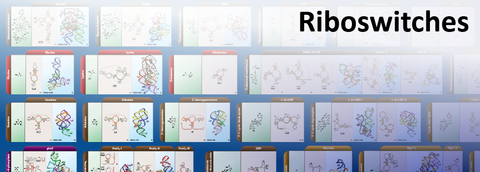
Riboswitches are a type of natural genetic control
element that use untranslated sequence in an mRNA to form a binding
pocket for a metabolite that regulates expression of that gene.
Seven riboswitches are under investigation and it appears as though
this mechanism of genetic regulation is widespread in bacteria.
These natural RNA switches are the latest illustration of how functional
RNAs are engaged in fundamental cellular processes.
Riboswitches are dual function molecules that undergo
conformational changes and that communicate metabolite binding typically
as either increased transcription termination or reduced translation
efficiency via an expression platform. Some riboswitches have been
detected in eukaryotes, supporting the view that riboswitches might
be an ancient form of genetic control that has persisted since the
"RNA World." The evolutionary consequences of this finding
are being explored.
|
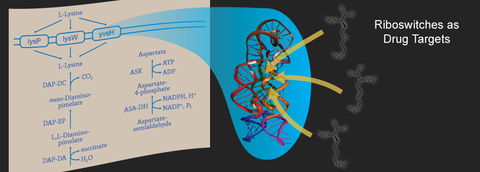
Many antibiotics bind to ribosomal
RNAs and selectively inhibit bacterial growth. We are beginning
to investigate whether riboswitches might also be targeted by new
classes of antibiotics. Given the significant role that riboswitches
play in bacterial genetic control and the fact that they have evolved
to bind metabolites, we suspect that drug compounds could be created
that disrupt bacterial genetic control. Furthermore, engineered
riboswitches might function as designer genetic control elements.

Natural Riboswitch Targets:
Coenzyme B12
Thiamine pyrophosphate
FMN
S-adenosylmethionine
Guanine
Adenine
Lysine
Download Riboswitch
Presentation: powerpoint (1.39 MB)
|
|
|